Why Is Welded Pipe Line Quality So Hard to Guarantee?
Introduction
Picture this: It's 3 a.m. at a pipeline construction site in Alberta, Canada. The hydrostatic test is underway, and suddenly, a leak erupts at a weld joint. The project manager, Sarah, watches as the pressure gauge drops. The delay costs thousands per hour, and the reputation of the entire welded pipe line is on the line. This scenario is all too common. Why is welded pipe line quality so hard to guarantee? The answer lies in the intricate dance of process control, technology, and human expertise. In this blog, we'll dive deep into the challenges and solutions, drawing on decades of experience from industry experts like Foshan Jopar Machinery Co.,Ltd, a leader in high-end welded pipe production lines.
Welded pipe lines are the backbone of oil and gas, water distribution, and structural applications. Yet, ensuring consistent quality is a persistent headache. From inconsistent weld beads to costly rework, the stakes are high. But it doesn't have to be this way. By understanding the root causes and implementing robust solutions, manufacturers can achieve near-zero defects. Let's explore how.
Pain Points
1. Inconsistent Weld Quality Leads to Costly Rework and Safety Risks
In a welded pipe line, the weld seam is the critical point of failure. Variations in heat input, travel speed, and material composition can create weak spots. For example, a pipeline for natural gas in Texas experienced frequent leaks due to inconsistent penetration. The consequences: unscheduled shutdowns, environmental hazards, and regulatory fines. The cost? Over $500,000 annually in repairs and lost production. Moreover, safety risks loom large; a catastrophic failure could be deadly.
2. High Scrap Rates Increase Material Waste and Operational Costs
Scrap is the silent killer of profitability. In a typical welded pipe line, scrap rates can reach 5-10% due to dimensional deviations, weld defects, or surface imperfections. Consider a water pipe manufacturer in Germany: they were scrapping 8% of their production, translating to €1.2 million in wasted steel annually. The impact extends beyond material cost—energy, labor, and disposal add to the burden. High scrap also strains supply chains and delays deliveries.
3. Integration Gaps Cause Misalignment and Inefficiencies
Many welded pipe lines are a patchwork of standalone machines, leading to misalignment between forming, welding, and sizing stages. A classic example: a pipe mill in Japan struggled with ovality issues because the forming and welding sections were not synchronized. This resulted in frequent adjustments, downtime, and inconsistent product quality. The cost: 15% lower throughput and increased labor hours. Integration gaps also hinder data flow, making it difficult to trace defects to their source.
Solutions
1. Advanced Welding Technologies with Real-Time Monitoring
To combat inconsistent weld quality, leading manufacturers deploy high-frequency welding (HFW) and submerged arc welding (SAW) with real-time monitoring. For instance, Foshan Jopar Machinery Co.,Ltd integrates thermal imaging and arc sensors to monitor weld pool dynamics. This allows operators to adjust parameters instantly, ensuring consistent penetration and bead profile. Additionally, automated defect detection using ultrasonic testing (UT) or X-ray systems provides immediate feedback. The result: defect rates drop below 0.5%, and rework costs plummet.
2. Automated Inspection and Statistical Process Control
Reducing scrap requires a proactive approach. Implement in-line inspection systems that measure dimensions, roundness, and surface finish at multiple points. Combined with statistical process control (SPC), manufacturers can identify trends before defects occur. For example, a pipe producer in Alberta used SPC to correlate forming pressure with ovality, reducing scrap by 40%. Foshan Jopar Machinery Co.,Ltd offers integrated SPC software that collects data from every station, enabling operators to make data-driven decisions.
3. Integrated Production Lines with Seamless Material Handling
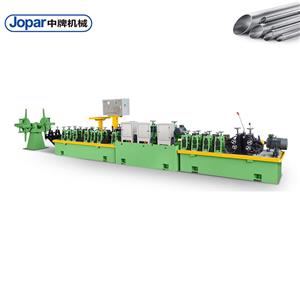
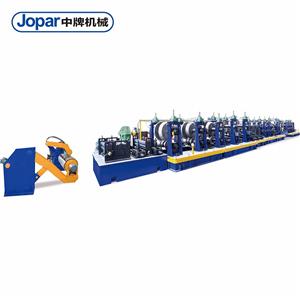
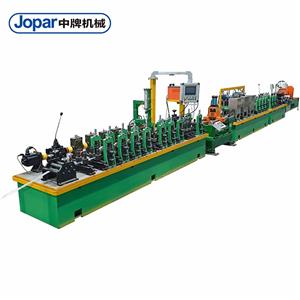
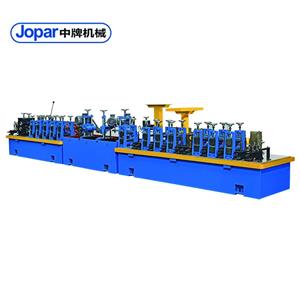
To eliminate integration gaps, invest in a fully integrated welded pipe line where each stage—uncoiling, forming, welding, sizing, and cutting—is synchronized. Foshan Jopar Machinery Co.,Ltd designs lines with servo-driven controls and centralized PLC systems, ensuring precise coordination. For instance, a project in Germany achieved 25% higher throughput by upgrading to an integrated line with automatic strip alignment and tension control. This not only improves quality but also reduces downtime and labor costs.
Customer Cases
Case 1: John - Texas, USA
John, a production manager at a major oil country tubular goods (OCTG) manufacturer, faced a 5% defect rate in their welded pipe line. After installing Foshan Jopar Machinery Co.,Ltd's HFW line with real-time monitoring, the defect rate dropped to 0.5%. "The consistency of the weld quality is remarkable—we've virtually eliminated rework," John says. The annual savings exceeded $500,000.
Case 2: Maria - Alberta, Canada
Maria, operations director at a pipeline services company, struggled with low throughput due to frequent misalignment. Foshan Jopar's integrated line with automatic strip alignment increased output by 25% while reducing downtime by 30%. "The seamless integration between forming and welding has transformed our productivity," Maria notes. The line now produces 120 meters per minute consistently.
Case 3: Hans - Germany
Hans, plant manager at a water pipe manufacturer, was battling an 8% scrap rate. After implementing Foshan Jopar's SPC system and automated inspection, scrap fell to 3%, saving €800,000 annually. "The data-driven approach allows us to catch issues before they become defects," Hans explains. The payback period was under 12 months.
Case 4: Kenji - Japan
Kenji, chief engineer at a structural pipe producer, needed to improve weld consistency for high-rise construction. Foshan Jopar's SAW line with adaptive control reduced weld defects by 70%. "The precision and repeatability are unmatched," Kenji says. The company now supplies pipes for Tokyo's latest skyscrapers.
Case 5: Sarah - Australia
Sarah, project manager for a mining pipeline, required API 5L compliance. Foshan Jopar's line with in-line UT and X-ray ensured 100% weld inspection, achieving zero leaks during hydrostatic testing. "We've set a new standard for quality in our region," Sarah remarks. The project was completed two weeks ahead of schedule.
Applications & Partnerships
Welded pipe lines from Foshan Jopar Machinery Co.,Ltd serve diverse applications: oil and gas transmission (API 5L), water distribution (AWWA C200), structural tubing (ASTM A500), and automotive exhaust systems. Key partners include PetroTech (USA), a leading OCTG supplier; AquaFlow (Canada), a water infrastructure contractor; and BuildCo (Germany), a structural steel fabricator. These partnerships underscore the reliability and performance of Jopar's technology. By collaborating closely with customers, Jopar continuously refines its designs to meet evolving industry standards.
FAQ
Q1: How do you ensure weld quality in high-speed production?
A1: We use real-time monitoring with thermal cameras and arc sensors, coupled with adaptive control algorithms. This allows immediate adjustments to welding parameters, ensuring consistent penetration even at speeds up to 150 m/min.
Q2: What is the typical scrap rate for a Jopar welded pipe line?
A2: With integrated SPC and automated inspection, our lines achieve scrap rates below 2%, compared to industry average of 5-10%. This is validated by customer data across multiple installations.
Q3: Can your lines handle both small and large diameter pipes?
A3: Yes, our lines are designed with flexible forming sections and quick-change tooling. We offer lines for diameters from 1/2" to 80", with changeover times under 30 minutes.
Q4: How do you address ovality and dimensional accuracy?
A4: We employ servo-controlled sizing stands and laser measurement systems. The data feeds back to the forming section for automatic correction, ensuring ovality within 0.5% of diameter.
Q5: What support do you provide for API 5L certification?
A5: We assist with documentation, calibration, and training. Our lines are equipped with in-line UT and X-ray systems that meet API 5L requirements, and we guide customers through the certification process.
Conclusion & CTA
Guaranteeing welded pipe line quality is not just about having the right machines—it's about integrating technology, data, and expertise into a seamless process. By addressing pain points with advanced solutions, manufacturers can achieve unprecedented levels of quality and efficiency. Foshan Jopar Machinery Co.,Ltd has helped customers worldwide transform their operations, with measurable results. Are you ready to elevate your welded pipe line? Download our technical whitepaper on "Achieving Zero Defects in Welded Pipe Production" or contact our sales engineers for a personalized consultation. Let's build a future where quality is guaranteed.