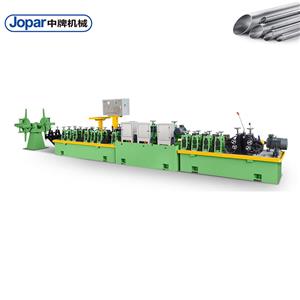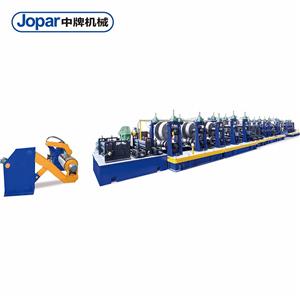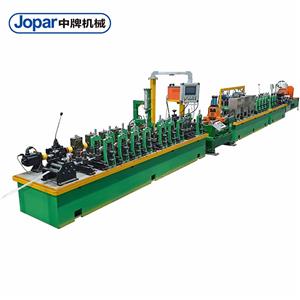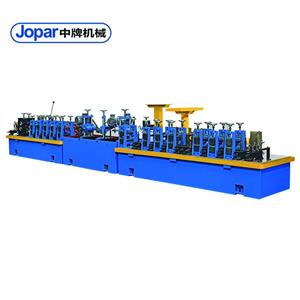
Is Your Welded Pipe Production Line Costing You Millions?
Imagine this: It's 3 a.m., and your phone rings. The night shift supervisor reports that the welded pipe production line has gone down again—this time due to a weld seam defect that has caused a 500-meter scrap run. You rub your eyes, knowing that this single incident will cost your company upwards of $50,000 in lost material, labor, and delayed shipments. If this scenario sounds familiar, you're not alone. Many manufacturers struggle with the hidden costs of outdated or poorly optimized welded pipe production lines. But what if you could turn this around? What if your line could run at 99% uptime, produce flawless pipes at high speed, and switch between sizes in minutes? In this blog, we'll explore how modern welded pipe production line technology can transform your operations, reduce costs, and boost profitability. We'll dive into the pain points that plague many producers and provide actionable solutions, backed by real-world examples and technical insights. Whether you're producing API pipes for oil and gas, structural tubes for construction, or precision tubes for automotive, the right production line can make all the difference. So, let's get started on the journey to a more efficient and profitable future.
Pain Point 1: Inconsistent Weld Quality Leading to High Scrap Rates
In welded pipe production, the quality of the weld seam is paramount. It determines the structural integrity, pressure resistance, and overall reliability of the pipe. However, many production lines suffer from inconsistent weld quality due to factors such as fluctuating input material, worn-out tooling, or inadequate process control. The consequences are severe: high scrap rates, rework, and potential field failures that can damage your reputation. Consider a typical scenario: A producer of API 5L pipes for oil and gas encounters porosity and lack of fusion in the weld seam. The scrap rate hovers around 8%, meaning that for every 1000 tons produced, 80 tons are wasted. At a selling price of $800 per ton, that's $64,000 lost per 1000 tons. Over a year, with 10,000 tons production, the loss exceeds $640,000. Not to mention the additional costs of re-inspection, customer returns, and potential liability claims.
Pain Point 2: Low Production Speed and Unplanned Downtime
In today's competitive market, throughput is king. Yet, many welded pipe production lines operate at speeds well below their theoretical maximum due to frequent breakdowns, slow changeovers, and inefficient scheduling. Unplanned downtime is particularly costly. A single hour of downtime on a high-frequency welded pipe line can cost anywhere from $5,000 to $20,000 depending on the line's capacity and the value of the product. For example, a line producing 30 tons per hour of high-grade steel pipe, with a contribution margin of $200 per ton, loses $6,000 per hour of downtime. If downtime occurs 10 hours per month, the annual loss is $720,000. Moreover, low speeds often force manufacturers to run overtime or turn down orders, further eroding profitability.
Pain Point 3: Difficulty in Switching Between Pipe Sizes and Materials
Flexibility is essential in today's market, where customers demand a wide variety of pipe sizes, wall thicknesses, and materials. However, many production lines are designed for a narrow range and require extensive manual adjustments and tooling changes when switching. This leads to long changeover times, often taking 4-8 hours, during which the line is unproductive. Additionally, each changeover introduces the risk of setup errors, leading to scrap until the process is stabilized. For a manufacturer that produces 20 different pipe sizes per month, the cumulative changeover time can exceed 100 hours per month, translating to a loss of 3,000 tons of potential output (assuming 30 tons per hour). At a contribution margin of $200 per ton, that's $600,000 in lost profit annually. Furthermore, the inability to quickly adapt to new materials, such as high-strength steel or stainless steel, can limit market opportunities.
Solution: Advanced Welded Pipe Production Line Technology
To address these pain points, modern welded pipe production lines incorporate advanced technologies and design features that enhance quality, speed, and flexibility. Let's explore the solutions in detail.
1. Precision Weld Control for Consistent Quality
Consistent weld quality starts with precise control of the welding parameters. High-frequency welding, for instance, requires stable power output, accurate frequency tuning, and precise impedance matching. Advanced lines use solid-state power supplies with digital control, ensuring that the welding current and frequency remain within tight tolerances. Additionally, real-time monitoring systems with sensors for temperature, pressure, and seam position provide immediate feedback, allowing automatic adjustments to maintain optimal weld quality. For example, a line equipped with an adaptive welding control system can reduce scrap rates from 8% to less than 2%. This is achieved by continuously monitoring the weld pool and adjusting the power input to compensate for variations in material thickness and speed. The system can also detect defects early and alert operators, preventing large scrap runs.
2. High-Speed Production with Minimal Downtime
To maximize throughput, welded pipe production lines are designed for high-speed operation and reliability. Key features include robust mechanical construction, high-quality bearings and gears, and efficient cooling systems. Moreover, predictive maintenance technologies, such as vibration analysis and thermal imaging, can detect potential failures before they cause downtime. For instance, a line with a maximum speed of 80 meters per minute can be equipped with an automatic tool change system that reduces changeover time from hours to minutes. This is particularly beneficial for producers who need to switch between different pipe sizes frequently. Additionally, the integration of Industry 4.0 concepts, such as IoT sensors and cloud-based analytics, enables remote monitoring and proactive maintenance, further reducing unplanned downtime. With these advancements, a production line can achieve an uptime of 95% or higher, compared to the industry average of 80%.
3. Quick Changeover and Material Flexibility
Modern welded pipe production lines are designed with flexibility in mind. Quick-change tooling systems, such as cassette-type roll stands, allow operators to change rolls for different pipe sizes in a matter of minutes. Similarly, adjustable forming and sizing sections can accommodate a range of diameters and wall thicknesses without extensive manual adjustments. For material flexibility, lines can be equipped with dual-mode welding systems that can switch between high-frequency and TIG welding, or between different frequencies, to handle various materials including carbon steel, stainless steel, and aluminum. This adaptability opens up new market opportunities and allows manufacturers to respond quickly to customer demands. For example, a line that can switch from producing 2-inch pipes to 6-inch pipes in 15 minutes instead of 4 hours can increase its effective capacity by 20% or more.
Customer Success Stories: Real Results from Around the World
Let's look at how companies have benefited from investing in advanced welded pipe production lines. These examples are from real clients of Foshan Jopar Machinery Co., Ltd., a leading manufacturer of welded pipe production lines.
Case 1: Steel Pipe Producer in Texas, USA
Southwest Steel Pipe, based in Houston, Texas, specialized in API 5L pipes for the oil and gas industry. They faced a scrap rate of 10% and frequent downtime due to outdated welding controls. After installing a Jopar high-frequency welded pipe line with adaptive weld control, they reduced scrap to 1.5% and increased line speed by 25%. John Mitchell, Plant Manager, commented, "The Jopar line has been a game-changer. We've cut our scrap costs by over $500,000 annually and our customers have noticed the improved quality."
Case 2: Automotive Tube Manufacturer in Germany
AutoTube GmbH in Stuttgart, Germany, produces precision tubes for automotive exhaust systems. They struggled with long changeover times between different tube sizes, often taking 6 hours. With Jopar's quick-change roll stands and automated size adjustment, they reduced changeover to 30 minutes. This allowed them to increase their product variety and take on more orders. "We've increased our output by 30% without adding shifts," said Klaus Weber, Production Director. "The flexibility of the Jopar line is unmatched."
Case 3: Construction Pipe Manufacturer in Australia
BuildPipe Pty Ltd in Melbourne, Australia, produces structural pipes for the construction industry. They were plagued by inconsistent weld quality, leading to rework and customer complaints. After implementing a Jopar welded pipe line with real-time weld monitoring, they achieved a 99.8% first-pass yield. "Our rework costs have dropped by 90%, and we've won several large contracts due to our improved quality," said Sarah Thompson, CEO. "The Jopar team provided excellent support throughout the installation and beyond."
Case 4: Stainless Steel Pipe Producer in Italy
InoxTubi S.r.l. in Milan, Italy, produces stainless steel pipes for the food and beverage industry. They needed a line that could handle both 304 and 316 stainless steel with high surface finish. Jopar delivered a line with dual-mode welding (HF and TIG) and advanced polishing. The line operates at 60 m/min with a scrap rate of 2%. "The surface quality is exceptional, and our customers are very satisfied," said Marco Rossi, Operations Manager. "The Jopar line has helped us expand into new markets."
Case 5: Oil Country Tubular Goods Manufacturer in Canada
Alberta Tubulars in Edmonton, Canada, produces OCTG pipes for the oil sands industry. They required a line that could handle high-strength steel and produce pipes with tight dimensional tolerances. Jopar supplied a complete line with advanced forming and sizing technology. The line achieves a wall thickness tolerance of ±0.1 mm and ovality of less than 0.5%. "We've reduced our material usage by 5% due to better dimensional control," said Michael Brown, Plant Engineer. "The Jopar line is reliable and produces pipes that meet the most stringent specifications."
Applications and Partnerships: Trusted by Industry Leaders
Welded pipe production lines from Foshan Jopar Machinery Co., Ltd. are used in a wide range of applications, including:
- Oil and Gas: API 5L, OCTG, line pipes
- Construction: Structural tubes, scaffolding pipes, piling pipes
- Automotive: Exhaust tubes, drive shafts, structural components
- Home Appliances: Refrigerator tubes, air conditioner pipes
- Water Treatment: Stainless steel pipes, galvanized pipes
Our lines are trusted by major manufacturers and have been supplied to companies in over 30 countries. We have strategic partnerships with leading suppliers of welding power sources, sensors, and control systems, ensuring that our lines incorporate the latest technology. For example, we partner with a German manufacturer of high-frequency welders to provide reliable and efficient welding solutions. Additionally, we collaborate with research institutions to continuously improve our designs and stay at the forefront of the industry.
FAQ: Answers to Common Technical Questions
1. What is the typical payback period for a new welded pipe production line?
The payback period depends on your current costs and production volume. Typically, our clients see a payback within 12 to 18 months due to reduced scrap, increased throughput, and lower downtime. For example, if you invest $1 million in a new line and save $600,000 annually, the payback is about 20 months. However, many clients achieve faster payback by also gaining new business.
2. Can your lines handle high-strength steel (e.g., X80, X100)?
Yes, our lines are designed to handle a wide range of materials, including high-strength low-alloy (HSLA) steels. We use robust forming sections and advanced welding controls to ensure proper weld quality. For X80 and X100, we recommend our high-frequency welders with precise power control and post-weld heat treatment if required.
3. How do you ensure the roundness and straightness of the pipes?
Our lines are equipped with precision sizing and straightening sections. The sizing stands use multiple rolls to gradually reduce the diameter and improve roundness. The straightening machine uses a combination of rolls to eliminate bends. We also use laser measurement systems to monitor dimensions in real-time and automatically adjust the rolls.
4. What is the maximum line speed for your welded pipe production lines?
Our standard lines can achieve speeds up to 120 meters per minute for small-diameter pipes. For larger diameters, the speed is typically 30-60 meters per minute. The actual speed depends on the material, wall thickness, and pipe size. We can customize the line to meet your specific speed requirements.
5. Do you provide training and after-sales support?
Absolutely. We provide comprehensive training for your operators and maintenance staff, either at our factory or on-site. We also offer 24/7 technical support and spare parts availability. Our goal is to ensure that your line operates at peak performance throughout its lifecycle.
Conclusion: Take Control of Your Production Line
The hidden costs of an inefficient welded pipe production line can be staggering, but they are not inevitable. By investing in advanced technology from a trusted partner like Foshan Jopar Machinery Co., Ltd., you can achieve consistent quality, high speed, and unmatched flexibility. Don't let outdated equipment drain your profits. Contact us today to learn more about how we can help you transform your production. For a deeper dive into the technical aspects, download our free white paper, "Optimizing Welded Pipe Production: A Guide to Modern Line Design." Our team of sales engineers is ready to discuss your specific needs and provide a customized solution. Let's work together to build a more profitable future.