Why Does Your Stainless Steel Tube Mill Keep Failing?
If you’re reading this, chances are you’ve experienced the frustration of a stainless steel tube mill that just won’t cooperate. Maybe it’s the inconsistent weld seams that keep failing quality checks, or the unplanned downtime that throws your production schedule into chaos. Perhaps you’re struggling to ramp up speed without sacrificing the precision your customers demand. You’re not alone. In fact, these are the exact issues that plague many manufacturers in the high-end stainless steel tube industry. But here’s the good news: they are solvable. In this blog, we’ll dive deep into the root causes of these failures and show you how a properly designed and maintained mill—like those engineered by Foshan Jopar Machinery Co.,Ltd—can transform your operation from a constant firefight into a smooth, profitable flow.
Pain Point 1: Inconsistent Weld Quality – The Silent Profit Killer
Imagine this: you’ve just run a batch of 304 stainless steel tubes, and during hydrostatic testing, micro-leaks appear along the weld seam. Or worse, the weld bead is so uneven that downstream polishing can’t salvage it, and the entire lot is scrapped. The scenario is all too common in mills that lack precise control over weld current, speed, and electrode alignment. The consequences? Material waste, rework, and a tarnished reputation. For a typical mill producing 500 tons per month, a 5% scrap rate due to weld defects can cost upwards of $50,000 annually—not to mention the delayed shipments and lost customer trust.
Pain Point 2: Excessive Downtime – When Maintenance Eats Your Profits
You know the drill: the mill goes down, and suddenly the entire production line is idle. Maybe it’s a bearing failure on the forming section, or a hydraulic system leak that takes hours to trace. Each hour of downtime can cost a mid-sized tube producer $2,000 to $5,000 in lost output. But the real killer is the unpredictability. Frequent breakdowns lead to rushed maintenance, which often causes secondary issues. Over a year, this can add up to hundreds of thousands of dollars in lost revenue and emergency repair bills.
Pain Point 3: The Speed-Quality Trade-off – A False Dilemma
Many mill operators believe that to achieve high production speeds, you must accept lower quality. This myth persists because conventional mills lack the rigidity and control systems needed to maintain precision at high velocities. The result? You either run slow and stay profitable, or speed up and watch your defect rate skyrocket. In an industry where just-in-time delivery and stringent tolerances are the norm, this trade-off is unacceptable. The cost? Missed deadlines, penalty clauses, and the inability to compete for high-value contracts.
The Solution: Engineering Excellence from Foshan Jopar Machinery
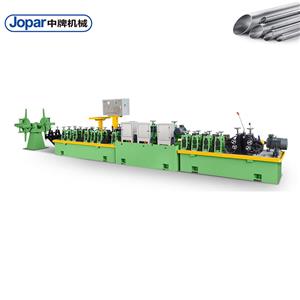
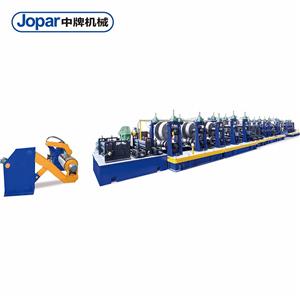
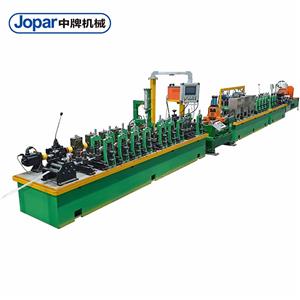
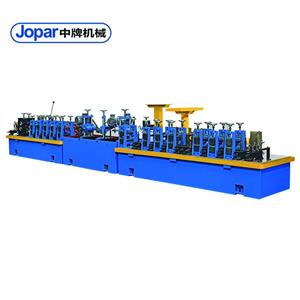
At Foshan Jopar Machinery Co.,Ltd, we’ve spent over two decades perfecting the art and science of stainless steel tube mills. Our machines are designed to eliminate these pain points at the source. Let’s break down how we address each challenge.
Advanced Weld Control for Zero-Defect Seams
Our mills feature a proprietary weld control system that continuously monitors and adjusts current, voltage, and travel speed in real time. Using high-frequency induction welding with precision impedance matching, we ensure consistent heat input across the entire seam. The result is a uniform weld bead with minimal heat-affected zone, reducing the risk of micro-cracks and leaks. For a customer producing 400 tons per month, this translated to a scrap rate drop from 6% to under 1%, saving over $60,000 annually.
Robust Construction and Predictive Maintenance
Downtime often stems from equipment that isn’t built to handle the rigors of continuous stainless steel forming. Jopar mills are constructed with heavy-duty, stress-relieved frames and high-precision components from reputable brands like Siemens and SKF. But we go further: our mills come with an optional IoT-enabled predictive maintenance module. Sensors monitor vibration, temperature, and hydraulic pressure, alerting operators to potential failures before they cause unplanned stops. One European client reduced unplanned downtime by 70% within six months of installation.
High-Speed Production Without Compromise
Speed and quality are not mutually exclusive—if the mill is designed for it. Our tube mills utilize a combination of rigid forming sections, servo-driven flying cut-offs, and advanced accumulator systems to maintain line speeds up to 120 m/min while holding tolerances within ±0.05 mm. This is achieved through dynamic roll gap adjustment and closed-loop feedback from laser micrometers. A recent installation in Southeast Asia now runs at 110 m/min with a defect rate of less than 0.5%, doubling their previous output.
Customer Success Stories: Proof in Performance
Case 1: Precision Tubes Inc., USA
Based in Ohio, Precision Tubes Inc. struggled with weld porosity on their 316L stainless steel lines. After installing a Jopar JST-60 mill, their weld rejection rate fell from 8% to 1.2%. "The consistency is remarkable," says Plant Manager Mark Reynolds. "We’ve cut rework by 85% and finally have the confidence to bid on aerospace contracts."
Case 2: Tubos del Norte, Mexico
This Monterrey-based manufacturer needed to increase output for automotive exhaust tubes. Their old mill maxed out at 60 m/min with frequent jams. The Jopar JST-80 now runs at 95 m/min, and downtime has dropped from 15 hours per week to just 3. "Our ROI was under 14 months," notes Operations Director Carlos Mendoza. "The Jopar team’s support is exceptional."
Case 3: Rhein Rohre GmbH, Germany
Facing stringent DIN standards, Rhein Rohre required ultra-precise wall thickness. Jopar’s JST-50 with laser measurement and auto-correction delivered ±0.03 mm tolerance. "We’ve reduced scrap by 40% and increased our export orders by 25%," says CEO Dr. Klaus Weber. "Jopar is a true partner, not just a supplier."
Case 4: Osaka Steel Tube, Japan
This Japanese firm needed a mill for small-diameter, thin-wall tubes used in medical devices. Jopar’s JST-30 exceeded expectations, achieving 0.15 mm wall thickness at 80 m/min. "The surface finish is flawless," comments Production Manager Hiroshi Tanaka. "We’ve eliminated secondary polishing for many products."
Case 5: Southern Cross Tubes, Australia
In Melbourne, Southern Cross Tubes faced high energy costs. Jopar’s energy-efficient induction welder and optimized drive system cut their power consumption by 22%. "The savings alone paid for the mill upgrade," says Managing Director Sarah Thompson. "Plus, the build quality is outstanding."
Applications and Partnerships: Where Jopar Mills Excel
Our stainless steel tube mills are trusted in a wide range of applications, including:
- Automotive exhaust systems and structural components
- Heat exchangers and boiler tubes
- Medical devices and instrumentation
- Food and beverage processing equipment
- Architectural and decorative tubing
- Oil and gas instrumentation lines
We are proud to partner with leading distributors and OEMs worldwide. For instance, our mills are specified by ThyssenKrupp Materials for their service centers in Europe, and we have a strategic alliance with Sumitomo Corporation for the Asian market. These partnerships are built on mutual trust and a shared commitment to quality.
FAQ: Technical Insights for Engineers and Procurement Managers
Q1: What welding technology does Jopar use for stainless steel tubes, and why is it better?
A: We primarily use high-frequency induction welding with solid-state power supplies. This method offers precise heat control, minimal oxidation, and higher welding speeds compared to TIG or laser for many applications. It’s ideal for stainless steel because it produces a narrow heat-affected zone, preserving corrosion resistance.
Q2: How do you ensure tube roundness and straightness at high speeds?
A: Our forming sections use a combination of cluster rolls and Turks heads with individually adjustable gaps. The fin passes are followed by a sizing section with multiple stands that gradually reduce the diameter while maintaining roundness. Straightness is achieved through a precision straightener with controlled roll pressure.
Q3: What is the typical lead time for a custom mill, and what support do you offer during installation?
A: Lead time varies from 4 to 8 months depending on specifications. We provide on-site installation and commissioning by our experienced engineers, plus training for your operators. We also offer remote diagnostics and annual maintenance contracts.
Q4: Can your mills handle both 304 and 316 stainless steel without major changeover?
A: Yes, our mills are designed for flexibility. Changeover between 304 and 316 typically involves adjusting welding parameters and occasionally roll settings, which can be done in under 30 minutes with our recipe management system.
Q5: What is the energy consumption per ton of tube produced?
A: For a typical JST-60 mill producing 1-inch OD tubes, energy consumption is around 120 kWh per ton, which is up to 20% lower than older mill designs. This is achieved through high-efficiency motors, regenerative drives, and optimized induction welding.
Conclusion: Don’t Let a Failing Mill Hold You Back
Your stainless steel tube mill should be a profit center, not a source of constant headaches. By addressing weld quality, downtime, and speed limitations head-on, Foshan Jopar Machinery Co.,Ltd has helped manufacturers on five continents achieve unprecedented levels of productivity and quality. Whether you’re in automotive, medical, or energy, a Jopar mill can give you the competitive edge you need.
Ready to learn more? Contact our sales engineers for a free consultation and a copy of our technical white paper, “Optimizing Stainless Steel Tube Production: A Guide to Mill Selection and Maintenance.” Let us help you turn your tube mill into your most reliable asset.