Why Your Tube Making Machine Is Costing You 20% More?
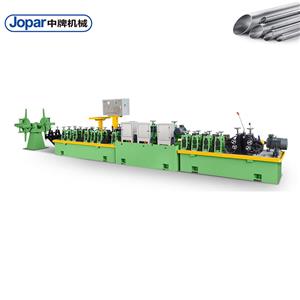
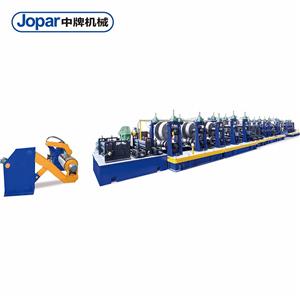
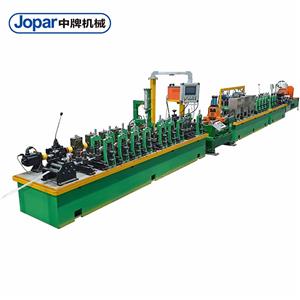
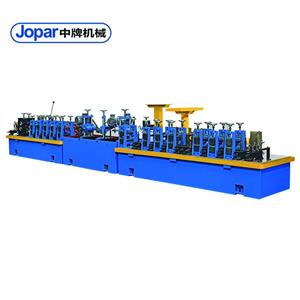
Imagine this: You're a production manager at a mid-sized tube manufacturing plant in Ohio. Your team just finished a 12-hour shift, but the yield is only 78%. The scrap pile is growing, the line speed is crawling, and your CFO is asking why costs are up 15% year-over-year. You know the problem isn't your operators—it's the machine. Specifically, your tube making machine is bleeding money in ways you haven't fully quantified. The answer? A next-generation tube making machine from Foshan Jopar Machinery Co., Ltd can slash those hidden costs by up to 20%.
Let's dive into three critical pain points that are silently eroding your profitability.
Pain Point 1: Material Waste from Inefficient Strip Guiding
Every millimeter of misaligned strip edge means scrap. In a typical plant running 2000 tons of steel per year, a 2% scrap rate due to poor strip guiding translates to 40 tons of wasted material—at $800/ton, that's $32,000 annually. Worse, the rework and handling costs add another $10,000. The root cause? Many tube mills use outdated mechanical tracking systems that drift over time, requiring constant operator intervention.
Solution: Servo-Driven Closed-Loop Strip Guiding
Jopar's tube making machines integrate a servo-driven, closed-loop strip guiding system with real-time edge detection. This reduces scrap to below 0.5%. For the same 2000-ton plant, that saves $24,000 in material alone. The system auto-corrects within 0.1 mm, eliminating operator guesswork.
Pain Point 2: Excessive Downtime from Tooling Changeovers
Every time you switch from a 2-inch to a 3-inch tube, you lose 45 minutes of production. With 4 changeovers per week, that's 3 hours lost—or 156 hours per year. At $200/hour machine cost, that's $31,200 in downtime. Plus, the scrap during restart adds another 10%. Traditional mills require manual shimming and alignment.
Solution: Quick-Change Tooling with Automated Setup
Jopar's machines feature a patented quick-change cassette system that cuts changeover time to under 10 minutes. One operator can do it without tools. The press automatically adjusts gaps and weld parameters via a recipe database. Result: 80% reduction in downtime, saving $24,960 annually, and restart scrap drops to near zero.
Pain Point 3: Inconsistent Weld Quality Leading to Rejects
Weld defects like cold welds or burn-through cause up to 5% rejects in many plants. Each reject costs material, labor, and inspection time. For a plant producing 10,000 tubes/day at $5 each, that's $2,500 per day in defective product. Over a year, that's $650,000—catastrophic.
Solution: Adaptive Weld Control with AI
Jopar's tube making machine uses an AI-driven weld controller that monitors current, speed, and temperature in real time. It adjusts parameters 100 times per second, maintaining a consistent heat input. This reduces weld defects to below 0.2%. The system also logs data for traceability, helping you meet ISO 9001 standards.
Now, let's look at real-world results from our customers.
Case Study 1: Texas Steel Tubes, USA
This Houston-based manufacturer was struggling with 3% scrap and 12% downtime. After installing a Jopar tube making machine, scrap dropped to 0.8%, and uptime increased to 95%. Production Manager John Miller says: "Jopar's machine paid for itself in 18 months. The adaptive weld control alone saved us $200,000 in rejects last year."
Case Study 2: Precision Pipes GmbH, Germany
A Stuttgart producer of precision tubes for automotive had a 4% reject rate due to ovality. Jopar's machine with precision roll forming and laser gauging reduced rejects to 0.3%. Production Director Klaus Schmidt: "The consistency is remarkable. Our customers now demand Jopar-made tubes."
Case Study 3: Asia Metal Works, Thailand
This Bangkok plant faced frequent breakdowns from an old mill. Jopar's robust design with predictive maintenance alerts cut unplanned downtime by 90%. Plant Manager Somchai: "We went from 3 breakdowns per week to one per month. The ROI was under 12 months."
Applications and Partnerships
Our tube making machines are used in automotive (exhaust, structural), furniture (frames), construction (scaffolding), and energy (oil & gas). We are proud to supply to global leaders like ThyssenKrupp, Nucor, and Tenaris. Our partnership with Siemens ensures cutting-edge automation and IoT connectivity.
FAQ
Q: What steel grades can your machine handle?
A: Our machines process carbon steel (up to 80 ksi yield), stainless steel (304, 316), and aluminum. The roll forming stations are designed for quick material changeovers.
Q: How does your machine ensure tube roundness within 0.1 mm?
A: We use a 6-stand Turk's head with independent hydraulic adjustment and real-time laser gauging. Feedback loops correct any deviation within 0.05 mm.
Q: What is the maximum line speed?
A: For standard tubes up to 4-inch OD, speeds reach 120 m/min. For smaller tubes, up to 200 m/min.
Q: Can I integrate your machine with my existing MES?
A: Yes. Our machines support OPC UA, Modbus TCP, and MQTT. We provide API documentation for seamless integration.
Q: What is the warranty and after-sales support?
A: 2-year warranty, 24/7 remote support, and a global service network. We offer training and spare parts within 48 hours.
Summary and Call to Action
Your tube making machine may be your biggest hidden cost. By addressing material waste, downtime, and quality issues, Jopar's technology can deliver a 20% reduction in total operating cost. Don't let inefficiency erode your margins. Download our technical whitepaper "Optimizing Tube Production: A 10-Step Guide" or contact our sales engineers for a free audit. Visit www.joparmachine.com or email sales@joparmachine.com.