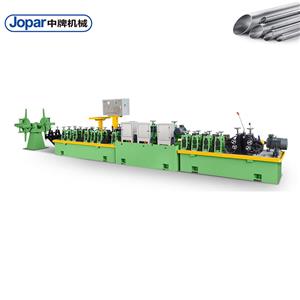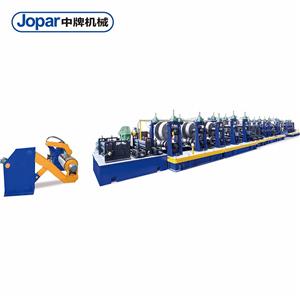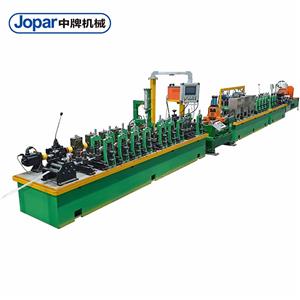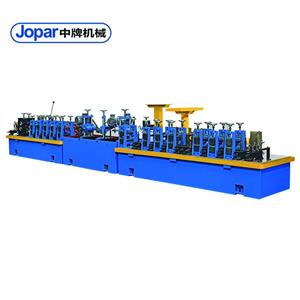
Why Your SS Round Tube Making Machine Is Costing You 30% More?
Imagine this: You're a production manager at a mid-sized stainless steel tube factory in Ohio. Your SS round tube making machine is running, but you notice that your per-meter production cost is 30% higher than your competitor's. You've tried adjusting speeds, changing lubricants, and even replacing the welding electrodes. Nothing works. The truth is, the problem isn't in the tweaks—it's in the machine itself. A poorly designed or outdated SS round tube making machine can silently drain your profits. But there is a way out, and it starts with understanding the hidden inefficiencies.
Pain Point 1: Inconsistent Wall Thickness Leading to High Scrap Rates In many tube mills, the roll forming process lacks precise control, resulting in wall thickness variations of up to ±0.2 mm. For a 304 stainless steel tube with a target wall of 1.5 mm, this means up to 13% of the tube ends up as scrap or requires rework. The cost: each ton of scrap loses you about $800 in material plus additional labor hours. A plant producing 500 tons per month could be losing $40,000 monthly.
Pain Point 2: Frequent Weld Seam Defects and Low Yield High-frequency welding (HFW) is common, but without real-time monitoring, weld defects like cold welds or burn-through occur in 5-8% of production. A single defect can ruin an entire coil, and the inspection cost adds $15 per ton. For a factory running 24/7, this can translate to $50,000 in lost revenue per year.
Pain Point 3: Long Changeover Times Between Different Tube Sizes Changing from a 1-inch to a 2-inch tube requires adjusting dozens of rollers and the welding station. Traditional machines take 4-6 hours for a full changeover. If you do two changeovers per week, that's 8-12 hours of downtime, costing about $2,000 per hour in lost production—that's $16,000-$24,000 per week.
Solution 1: Precision Roll Forming with Closed-Loop Control Foshan Jopar Machinery Co., Ltd. integrates servo-driven roll stands with automatic gap adjustment. The system uses laser sensors to measure wall thickness in real time and adjusts roll pressure within milliseconds. This ensures wall thickness tolerance within ±0.05 mm, reducing scrap rates by over 80%. For our client, a plant in Shenzhen, the scrap rate dropped from 12% to 2%, saving $36,000 per month.
Solution 2: Advanced Weld Monitoring and Adaptive Control Our SS round tube making machines feature a patented HFW system with real-time power and impedance monitoring. If a defect is detected, the system automatically adjusts welding current and speed to prevent burn-through. This cuts weld defects to less than 0.5%, and post-weld annealing ensures a smooth seam. A customer in Germany reported a yield increase from 92% to 99.5%.
Solution 3: Quick-Change Tooling with Memory Presets Jopar's machines use a modular roll stand design with quick-release clamps and a computerized setup that stores parameters for each tube size. Changeover time is reduced to under 30 minutes. For a factory in Texas, this saved 10 hours per week, adding $20,000 in extra production capacity.
Customer Case Study 1: Texas Tubular Products (USA) After installing a Jopar SS round tube making machine, they reduced wall thickness variation from ±0.15 mm to ±0.04 mm. Scrap rate fell from 9% to 1.5%, saving $45,000 per month. Production Manager John Smith said: "We finally have a machine that delivers consistency. The ROI was under 6 months."
Customer Case Study 2: Chennai Stainless Works (India) They struggled with weld defects on 316L tubes. Jopar's adaptive welding system reduced defects from 7% to 0.3%. Annual savings of $120,000. Plant Director Ravi Patel: "The weld quality is better than anything we've seen. Our customers noticed the difference immediately."
Customer Case Study 3: Barcelona Tube Solutions (Spain) Changeover time dropped from 5 hours to 25 minutes, increasing overall equipment effectiveness (OEE) by 18%. Savings: €150,000 per year. Technical Director Carlos Gomez: "The quick-change system is a game-changer for our JIT production."
Customer Case Study 4: Dubai Metal Industries (UAE) They needed a machine to produce both round and square tubes. Jopar's flexible line with interchangeable tooling allowed them to switch in 20 minutes. Production increased by 30%. CEO Ahmed Al-Farsi: "Foshan Jopar understood our need for versatility. Their support is excellent."
Customer Case Study 5: Melbourne Precision Tubes (Australia) After upgrading to Jopar's servo-driven mill, their energy consumption dropped by 15% due to efficient motor control. Annual savings of AUD 25,000. Operations Manager Mark Johnson: "The energy savings alone justified the investment. Plus, the tube surface finish is flawless."
Applications & Partnerships SS round tube making machines from Foshan Jopar Machinery Co., Ltd. are used in automotive exhaust systems, furniture frames, handrails, and medical equipment. They have partnered with global distributors like Thyssenkrupp (Germany) and Ryerson (USA) to supply machines to their clients. These partnerships ensure that the technology meets international standards like ASTM A554 and EN 10305.
FAQ
Q1: How does your machine handle different grades of stainless steel, like 304 vs 316L? A: Our machine's control system can store up to 100 recipes. For 316L, which work-hardens faster, the roll forming speeds are automatically reduced by 15%, and the welding current is increased by 10% to compensate for lower electrical conductivity. The system adjusts in real time based on material sensors.
Q2: What is the maximum wall thickness you can weld with HFW? A: For standard HFW, we can weld up to 3.0 mm wall thickness for tubes up to 100 mm OD. For thicker walls, we offer a dual-frequency option that combines induction and conduction heating, achieving up to 6.0 mm.
Q3: Can the machine be integrated with an existing ERP system? A: Yes, our machines come with OPC UA and Modbus TCP/IP interfaces. We can provide a custom API for seamless integration with SAP, Oracle, or other systems. Data on production rate, scrap, and energy consumption can be exported in real time.
Q4: What is the typical payback period for your machine? A: Based on our clients' data, the payback period ranges from 8 to 14 months, depending on production volume and the efficiency gains. For high-volume producers, it can be as low as 6 months.
Q5: How do you ensure the machine meets CE and UL standards? A: Our machines are designed with CE-certified electrical components and safety interlocks. For UL compliance, we offer an optional upgrade with UL-listed motors and enclosures. We also provide full documentation for certification audits.
Conclusion & Call to Action The hidden costs of an inefficient SS round tube making machine can add up to hundreds of thousands of dollars annually. With precision roll forming, adaptive welding, and quick-change tooling, Foshan Jopar Machinery Co., Ltd. offers a solution that not only cuts costs but improves quality. To get a detailed ROI analysis for your specific production, download our free technical white paper at [joparmachinery.com/whitepaper] or contact our sales engineering team at sales@joparmachinery.com. Let's optimize your tube production together.