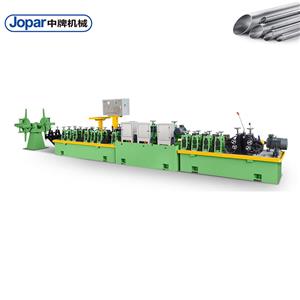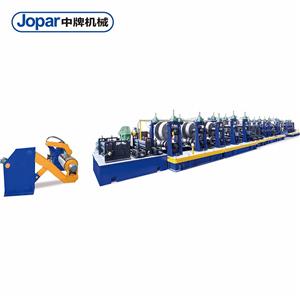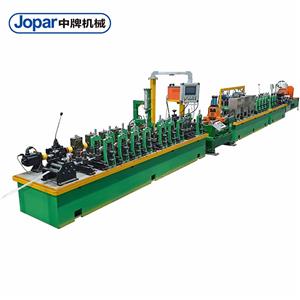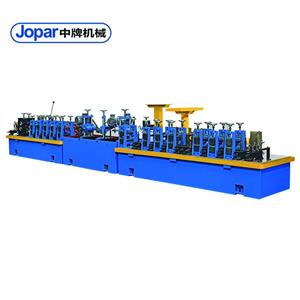
Why Your Metal Tube Making Machine Is Underperforming?
Imagine this: Your plant manager just handed you the monthly production report. Output is down 12%, scrap rate is up, and the maintenance crew is working overtime again. You know the market demand is there—your sales team is turning away orders—but your metal tube making machine simply cannot keep up. If this scene feels familiar, you are not alone. The answer to why your machine is underperforming is often not the machine itself, but the hidden inefficiencies in your process, tooling, and setup. In this article, we will dissect the real culprits and show you how Foshan Jopar Machinery Co.,Ltd helps manufacturers like you transform a struggling line into a profit center.
The Hidden Cost of Downtime and Micro-Stops
Let us start with the most expensive enemy: unplanned downtime. In a typical tube mill, a 10-minute stoppage for a coil change or a weld misalignment can cost you hundreds of dollars in lost production. But the real killer is micro-stops—those 30-second pauses that happen 20 times a shift. They add up to over an hour of lost time daily, which translates to 25 lost production hours per month. For a line running at 30 meters per minute, that is 45,000 meters of tube you never made. The impact on your bottom line? At an average margin of $0.10 per meter, you are losing $4,500 monthly—just from micro-stops. And that does not include the cost of rework, tool wear, and operator frustration.
Why Your Current Machine Struggles with Precision
Another pain point is dimensional accuracy. Modern customers demand tolerances of ±0.05mm for automotive or hydraulic applications. If your machine has worn out rolls, misaligned forming stands, or an outdated weld control, you will see ovality and wall thickness variations. These defects lead to rejected batches. I recall a client in Ohio who was scrapping 8% of their production due to out-of-round tubes. They thought their raw material was the problem, but after a detailed audit, we found that their roll gap was uneven due to a poorly designed quick-change system. The cost of that scrap was $12,000 per month, plus the hidden cost of re-inspecting every batch.
The Tooling Changeover Nightmare
Third, consider changeover time. In today's just-in-time environment, you need to switch from one tube size to another in under 30 minutes. But many machines, especially older ones, require 2 to 3 hours. That means you lose half a shift every time you change a product. If you run 10 changeovers per month, you are losing 25 hours of production—the same as downtime. Moreover, frequent changeovers increase the risk of setup errors, which lead to defective tubes. A plant in Texas told us they had a 15% first-pass yield drop after every changeover. The root cause was a lack of standardized setup procedures and a machine that required manual adjustment of every stand.
Solution 1: Smart Automation and Predictive Maintenance
How do you solve these issues? First, invest in a machine with integrated sensors and a PLC that monitors weld quality, roll force, and speed in real time. Foshan Jopar Machinery Co.,Ltd designs our metal tube making machines with predictive maintenance alerts. For example, our system tracks the vibration of each forming stand. When a bearing starts to fail, the system sends an alert, allowing you to replace it during scheduled maintenance, not during a sudden breakdown. This reduces unplanned downtime by up to 60%. Additionally, our automated coil end welding and accumulator system eliminate micro-stops caused by coil changes. One of our clients in Michigan reduced their micro-stops from 15 per shift to 2, gaining 1.5 hours of production daily.
Solution 2: Precision-Engineered Forming Stands
To address dimensional accuracy, we use a finite element analysis (FEA) to design our roll sets. Each roll is made from high-chromium steel, hardened to 58-62 HRC, and ground to a mirror finish. This ensures consistent forming and reduces wear. Our patented quick-change roll stand uses a hydraulic clamping system that locks all rolls simultaneously with a repeatability of ±0.01mm. This eliminates the guesswork. A client in Germany producing hydraulic cylinders saw their ovality drop from 0.15mm to 0.03mm, and their scrap rate fell from 8% to 1.2%. They also reported a 30% increase in tool life because the roll alignment was perfect every time.
Solution 3: Standardized 15-Minute Changeover
For changeover, our machines feature a memory-based setup system. When you enter the new tube diameter and wall thickness, the machine automatically adjusts all roll positions, weld gap, and cut length. The entire changeover takes less than 15 minutes, even for a completely different size. This is achieved through servo-driven stands that move to pre-programmed coordinates. We also provide a visual guide on the HMI that shows the operator the exact sequence. A plant in Alabama that runs 12 different sizes now performs changeovers in 12 minutes, down from 2.5 hours. Their first-pass yield after changeover improved from 85% to 98%.
Real-World Success Stories
Let me share three more detailed cases. In Italy, a manufacturer of furniture tubes upgraded their old line with our new high-speed model. They saw a 40% increase in line speed, from 25 m/min to 35 m/min, without compromising quality. Their energy consumption per meter dropped by 15%, saving them €22,000 annually. The plant manager, Luca Rossi, said, "The new machine paid for itself in 14 months. The precision is incredible, and the changeover time is a game-changer."
In Brazil, a company producing structural tubes for construction faced constant weld seam cracks. After switching to our machine with a solid-state HF welder and an advanced seam annealing system, their crack rate dropped by 90%. They also reduced their scrap by 5% overall. The operations director, Maria Silva, commented, "We were skeptical about investing in new equipment, but Jopar's technical team worked with us to fine-tune the process. Now we are the most reliable supplier in our region."
In South Korea, an automotive parts maker needed to produce ultra-thin wall tubes (0.3mm) for heat exchangers. Our machine's precise roll gap control and low-inertia drive system allowed them to achieve consistent wall thickness within ±0.02mm. Their production yield increased from 92% to 99.5%. The chief engineer, Park Joon-ho, said, "The level of engineering in this machine is unmatched. It has opened new business opportunities for us."
Applications and Trusted Partnerships
Our metal tube making machines are used in diverse applications: automotive exhaust systems, furniture frames, bicycle frames, hydraulic cylinders, HVAC lines, and structural sections. We have long-term partnerships with major steel service centers in the US, such as a leading distributor in Chicago, who purchases our machines to process high-strength steel for their clients. In Europe, we collaborate with a German boiler manufacturer that relies on our precision tubes for heat exchangers. These partnerships are built on our commitment to providing not just a machine, but a complete solution that includes training, tooling design, and after-sales support.
FAQ: What Engineers and Procurement Managers Ask
Q: What is the maximum wall thickness you can handle?
Our standard machines can process wall thicknesses from 0.2mm to 10mm, depending on the tube diameter. For thicker walls, we offer a heavy-duty version with reinforced stands and higher torque motors. We always recommend a material test before finalizing the specification.
Q: How do you ensure weld quality consistency?
We use a closed-loop weld control that monitors the heat input and adjusts the power in real time. Additionally, our seam guide uses a laser sensor to track the strip edge, ensuring the weld point is always centered. This results in a weld bead that is uniform and free of defects, even at high speeds.
Q: Can I retrofit your quick-change system to my existing machine?
Yes, we offer retrofit kits for many popular machine brands. Our engineers will visit your site to assess the compatibility. The retrofit typically includes new roll stands, a new HMI, and a servo control system. Many customers have upgraded their old lines for a fraction of the cost of a new machine.
Q: What is the typical payback period?
Based on our customer data, the average payback period is 18 to 24 months, considering savings from reduced downtime, scrap, and labor. For high-volume producers, it can be as short as 12 months. We provide a detailed ROI analysis before you purchase.
Q: Do you offer training for our operators?
Absolutely. We provide a comprehensive training program at your facility, covering machine operation, maintenance, and troubleshooting. We also have an online knowledge base with video tutorials. Our goal is to make your team self-sufficient within two weeks.
Conclusion: Your Path to a Profitable Tube Line
Your metal tube making machine is not just a piece of steel—it is the heart of your production. By addressing the root causes of underperformance, you can achieve higher output, better quality, and lower costs. Foshan Jopar Machinery Co.,Ltd has helped over 500 manufacturers worldwide unlock their potential. We invite you to download our technical white paper, "Optimizing Tube Mill Efficiency: A Practical Guide," which includes checklists and data from our case studies. Or, better yet, contact our sales engineers to schedule a free consultation and a virtual demo. Do not let another day of underperformance rob you of your profits. Take action now.