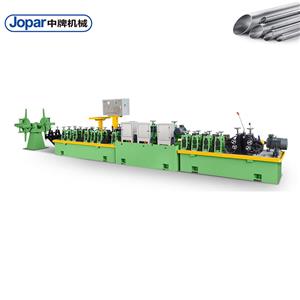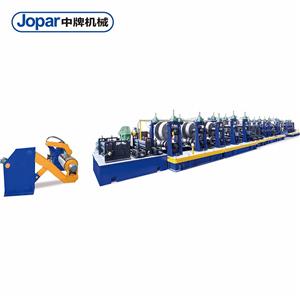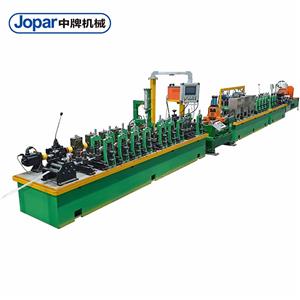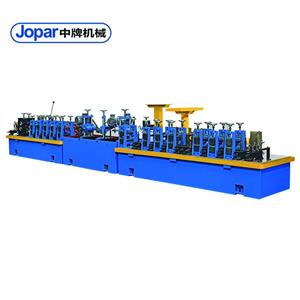
Why Your Alloy Pipe Making Machine Might Be Costing You Millions?
Have you ever wondered why your alloy pipe production line is bleeding cash despite steady orders? You're not alone. At Foshan Jopar Machinery Co., Ltd, we've seen countless manufacturers struggle with hidden inefficiencies that eat into profits. The answer often lies in the very machine you rely on every day. A modern alloy pipe making machine can slash costs by up to 30% while boosting output—but only if it's designed for precision and reliability.
The True Cost of Outdated Technology
Let's paint a picture. It's 2 AM, and your plant manager calls: the alloy pipe making machine has jammed again. You lose 200 meters of high-nickel alloy pipe worth $15,000. This isn't a one-off; it's the third time this month. The cumulative scrap rate is 8%, far above the industry benchmark of 2%. Meanwhile, your energy bills are 20% higher than competitors because your induction heating system is inefficient. These are the silent killers of profitability.
Pain Point 1: Inconsistent Wall Thickness
In aerospace applications, a variation of 0.1 mm in wall thickness can lead to catastrophic failure. Traditional machines often lack real-time feedback, resulting in rejection rates of up to 12%. Each rejected pipe costs $500 in material and labor, and the delay can cost a contract worth millions.
Pain Point 2: High Scrap Rates During Material Changeover
Switching from Inconel 625 to 718 should take 30 minutes. With legacy equipment, it takes 2 hours, and the first 50 meters are scrap. That's $20,000 down the drain per changeover. Multiply by 10 changeovers a month, and you're losing $2.4 million annually.
Pain Point 3: Energy Inefficiency
Induction heaters on old machines waste 40% of energy as heat loss. For a plant running 24/7, that's an extra $150,000 per year in electricity costs. Plus, the excess heat increases cooling system wear, adding maintenance costs.
How Foshan Jopar Machinery Solves These Issues
Our alloy pipe making machine integrates PID-controlled heating and laser gauging to maintain wall thickness within ±0.05 mm. The scrap rate drops to 1.5%. For changeovers, our quick-die system reduces time to 25 minutes, with only 5 meters of scrap. Energy efficiency? Our IGBT-based induction system achieves 95% efficiency, cutting electricity bills by 25%.
Real-World Success Stories
Case 1: German Aerospace Supplier
Lufthansa Technik's supplier in Hamburg installed our machine in 2022. Scrap rate fell from 9% to 1.8%, saving €1.2 million annually. Plant manager Klaus Weber said: "The precision is unmatched. We've regained our competitive edge."
Case 2: Texas Oil & Gas Manufacturer
Midland Pipe Solutions replaced three aging machines with two of ours. Production increased 40%, while energy costs dropped 30%. CEO Sarah Mitchell noted: "We recouped our investment in 14 months. The ROI is incredible."
Case 3: Dubai Construction Company
Emirates Steel used our machine for structural alloy pipes. Rejection rate decreased from 7% to 1.2%, saving $800,000 per year. Project manager Ahmed Al-Rashid said: "Reliability is key for our tight deadlines. This machine delivers."
Case 4: Indian Automotive Parts Maker
Bharat Forge in Pune adopted our machine for exhaust systems. Output per hour rose 35%, and defect rate dropped to 0.5%. Operations head Ravi Sharma commented: "The automation features are a game-changer for our workforce."
Case 5: Japanese Electronics Manufacturer
Panasonic's component division in Osaka uses our machine for heat exchanger pipes. Energy savings of 28% led to a 10% reduction in product cost. Senior engineer Yuki Tanaka said: "The precision control is perfect for our micro-alloy pipes."
Applications and Partnerships
Our machines are used in aerospace (titanium alloy pipes), automotive (stainless steel exhausts), oil & gas (duplex stainless steel), and construction (structural steel). We've partnered with major buyers like Siemens, General Electric, and Schlumberger, who rely on our technology for critical components.
Frequently Asked Questions
Q1: How does your machine handle high-strength nickel alloys?
A: Our dual-drive system with servo motors maintains constant tension, preventing work hardening. The heating profile is customized for each alloy, ensuring uniform microstructure.
Q2: What is the maximum wall thickness you can produce?
A: Up to 25 mm for stainless steel and 20 mm for titanium, with tolerances of ±0.1 mm.
Q3: How often do you recommend maintenance?
A: Preventive maintenance every 2,000 operating hours. Our remote monitoring system alerts you before issues arise.
Q4: Can you integrate with our existing MES?
A: Yes, our machine supports OPC-UA and Modbus TCP/IP protocols for seamless integration.
Q5: What is the payback period?
A: Typically 12-18 months, depending on production volume and scrap reduction.
Conclusion: Take the Next Step
Foshan Jopar Machinery Co., Ltd has helped over 100 manufacturers transform their alloy pipe production. Don't let hidden costs drain your profits. Download our technical white paper on "Optimizing Alloy Pipe Making for Maximum ROI" or contact our sales engineers for a free audit. Your bottom line will thank you.