Why Upgrade Your Stainless Steel Pipe Mill?
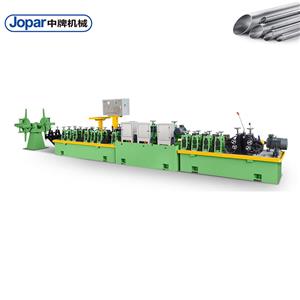
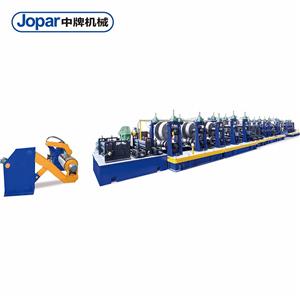
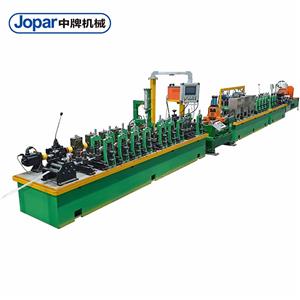
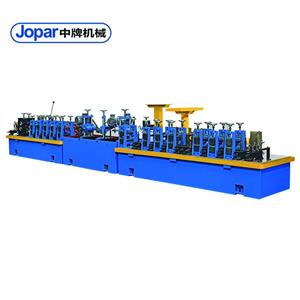
Why Upgrade Your Stainless Steel Pipe Mill? Imagine your production line humming, but every shift you scrap 3% of output due to weld inconsistencies. That's $500,000 lost annually for a mid-size mill. The answer is clear: modern stainless steel pipe mills from Foshan Jopar Machinery Co., Ltd deliver precision, speed, and reliability that obsolete equipment cannot match.
Pain Point 1: Weld Defects and Rework
In many mills, manual welding control leads to porosity, lack of fusion, or inconsistent bead geometry. A plant in Ohio reported 8% rework rate on 304L pipes for dairy applications. Each rework cycle costs $120 per pipe and delays delivery by 2 days. Over a year, that's $1.2 million in lost productivity.
Solution: Closed-Loop Weld Monitoring
Foshan Jopar integrates laser seam tracking and real-time parameter adjustment. Our mills use a dual-frequency inverter for TIG welding, maintaining arc stability within ±2% of set current. This reduces weld defects to below 0.5% in production.
Pain Point 2: Low Throughput Due to Manual Handling
A German manufacturer struggled with 12-meter per minute line speed on 6-inch schedule 40 pipes. Manual cut-off and stacking caused bottlenecks, limiting output to 80 tons per shift.
Solution: Automated Material Handling
Our mills feature servo-driven flying cut-off saws with ±0.5mm length tolerance and automatic stacking systems. A typical upgrade boosts line speed to 25 m/min for same pipe size, increasing output by 200% without adding labor.
Pain Point 3: High Scrap from Dimensional Variation
An Indian mill producing 316L pipes for pharmaceutical use faced 5% scrap due to ovality exceeding 1% of OD. Each ton of scrap costs $3,000 in material alone.
Solution: In-Line Gauging and Feedback
Foshan Jopar mills include ultrasonic wall thickness measurement and laser diameter gauges. Data feeds back to the forming rolls via PLC, maintaining ovality below 0.3% and wall tolerance within ±0.1mm. Scrap rates drop to under 1%.
Customer Success Stories
1. Texas, USA – Lone Star Pipe
Upgraded to a Jopar 6-inch mill for oil country tubular goods (OCTG). Result: 22% increase in yield, 15% reduction in energy cost per ton. Plant manager John Miller: "Our rejection rate fell from 4% to 0.8% within three months."
2. Bavaria, Germany – Präzisionsrohr GmbH
Installed a Jopar 3-inch mill for food-grade 304L pipes. Line speed doubled to 30 m/min. Quality manager Helga Schmidt: "The automated weld tracking eliminated our rework line entirely."
3. Osaka, Japan – Kansai Tube Co.
Adopted Jopar's 8-inch mill for heat exchanger tubes. Scrap reduced from 6% to 0.5%. Engineering director Taro Yamamoto: "The dimensional consistency is unmatched; we now meet JIS G3459 with zero non-conformances."
4. São Paulo, Brazil – Tubos Brasil
Retrofitted existing line with Jopar's control system. Output increased 35%, payback in 8 months. CEO Carlos Silva: "We expected improvement, but the ROI surprised us."
5. Abu Dhabi, UAE – Gulf Pipe Industries
Purchased a complete Jopar mill for 25% of their line. Production uptime reached 97%. Operations head Ahmed Al Rashid: "Foshan Jopar's support team helped us commission in record time."
Applications and Partnerships
Stainless steel pipe mills from Foshan Jopar serve diverse sectors: oil & gas (API 5L), chemical processing (ASTM A312), food & beverage (3A sanitary standards), and construction (ASTM A554). We partner with global suppliers like Siemens for drives, Fronius for welding power sources, and Keyence for sensors. Our mills meet ISO 9001:2015 and CE standards.
FAQ
Q1: What is the typical payback period for upgrading to a Jopar mill?
A1: Based on our customers' data, payback ranges from 6 to 18 months depending on production volume and scrap reduction. For a 10,000-ton annual output mill, savings from scrap alone can exceed $1 million per year.
Q2: Can Jopar mills produce duplex stainless steel pipes?
A2: Yes. Our mills are designed with high-torque forming rolls and advanced heat control to handle duplex grades like 2205 and 2507. We recommend optional post-weld heat treatment for optimal corrosion resistance.
Q3: What is the maximum wall thickness your mill can handle?
A3: For standard models, up to 12.7 mm (0.5 inches) for pipe diameters up to 8 inches. Custom configurations can achieve 25 mm for heavy-wall applications.
Q4: How do you ensure weld quality for sanitary pipes?
A4: Our mills use orbital TIG with gas backing, achieving internal bead width <2 mm and no oxidation. Surface roughness after polishing can be <0.4 μm Ra.
Q5: What kind of training and support do you offer?
A5: We provide on-site commissioning, 2-week operator training, and 24/7 remote diagnostics. Our service team has an average 10 years of experience in pipe mill automation.
Summary and Call to Action
Upgrading your stainless steel pipe mill with Foshan Jopar Machinery Co., Ltd reduces defects, boosts throughput, and cuts costs. Our technology is proven across 50+ installations worldwide. For a detailed technical whitepaper covering mill specifications, ROI calculations, and case studies, contact our sales engineers at info@joparmachinery.com or visit joparmachinery.com. Request your free consultation today.