Why Upgrade Your SS Pipe Manufacturing Machine Now?
The Hidden Costs of Sticking with Outdated SS Pipe Manufacturing Equipment
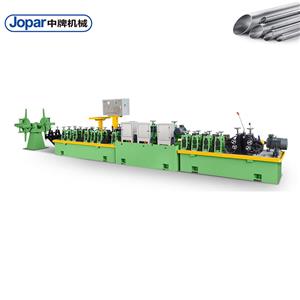
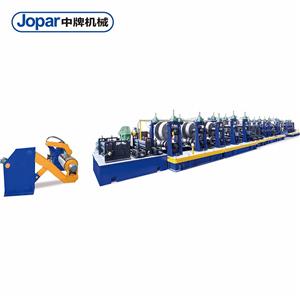
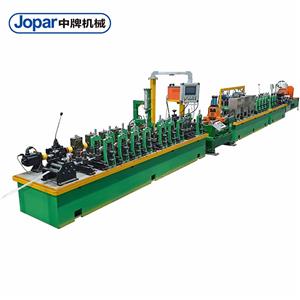
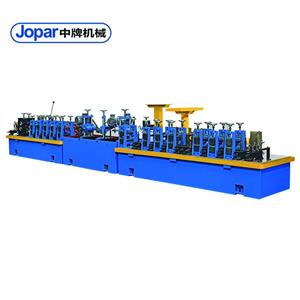
Imagine this: It's 2 a.m., and your plant manager calls with a familiar headache—the third unplanned downtime this month on your aging ss pipe manufacturing machine. The night shift is idle, the order from a German distributor is already late, and you're mentally calculating the penalty clause. This scenario plays out in too many tube mills across North America and Europe. The answer to the title question is simple: because the cost of not upgrading is far higher than the investment. Modern ss pipe manufacturing machine technology from Foshan Jopar Machinery Co.,Ltd doesn't just improve speed—it fundamentally changes your cost structure, quality consistency, and ability to win high-margin orders.
Pain Point #1: The Silent Profit Killer—Inconsistent Wall Thickness
Your current line might produce 80% within tolerance on a good day. But what about the 20% that goes to scrap or rework? For a mill producing 5,000 tons of stainless steel pipes annually, a 3% scrap rate means 150 tons of wasted material. At $2,500 per ton, that's $375,000 lost—before you count labor, energy, and machine hours. The deeper issue is that older roll forming and welding controls rely on manual adjustments. A skilled operator can compensate, but when he retires or takes a vacation, your quality becomes a lottery. The consequences ripple: rejected batches, customer audits failures, and a tarnished reputation in sectors like food processing or pharmaceuticals where wall thickness tolerances are non-negotiable.
Why this happens: Traditional machines lack real-time feedback loops. They can't adjust roll gaps or weld parameters dynamically as the strip temperature or thickness varies slightly. The result is a statistical spread that grows with machine wear.
Pain Point #2: Changeover Chaos—The Hidden Hourly Cost
Every time you switch from producing 1-inch to 2-inch pipes, you lose 4 to 6 hours. During that time, your team is wrenching on rolls, recalibrating, and test-running. If you do three changeovers per week, that's 12-18 hours of non-productive time. At an opportunity cost of $500 per hour in lost margin, that's $6,000 to $9,000 weekly—over $300,000 annually. Worse, rushed changeovers lead to setup errors that cause early defects in the first batches. Many plant managers accept this as normal, but it's not. The latest ss pipe manufacturing machine designs use servo-driven roll stands and pre-programmed recipe storage. A changeover that used to take half a shift now takes 45 minutes. That's not incremental improvement; it's a step-change in operational efficiency.
The human toll: Your experienced setup crew is stretched thin. They're the highest-paid hourly workers, and they're spending their time on manual adjustments instead of process optimization. This is a classic case where technology can free up your best people for higher-value tasks.
Pain Point #3: The Quality Certification Trap
To sell into the European pressure equipment market or the US pharmaceutical sector, you need documented traceability. Your current machine likely logs speed and temperature, but not the detailed weld parameters, roll pressure, or eddy current test results per pipe. When an auditor asks for batch data, you're scrambling through paper logs. This not only consumes engineering hours but can also cost you a certification renewal. A modern ss pipe manufacturing machine integrates with a central data system, automatically recording every parameter for each pipe. This isn't just about compliance—it's about being able to prove quality to a demanding customer in real time, which is often the difference between winning a contract and being a backup supplier.
The Solution: What Foshan Jopar's Advanced Line Offers
Foshan Jopar Machinery Co.,Ltd has engineered its ss pipe manufacturing machine to address these exact pain points. Instead of bolting on incremental features, they rethought the core architecture. The result is a line that combines a high-frequency welding system with an intelligent control unit that monitors wall thickness via laser sensors and adjusts the forming rolls in milliseconds. The changeover system uses memory-locked tooling carts that pre-position the rolls to within 0.01mm. And the data acquisition system is built to meet the strictest EU and US standards, including CE and ASME compliance.
For pain point #1: The closed-loop control reduces wall thickness variance by up to 40% compared to conventional lines. This directly translates to less scrap, fewer rejected coils, and the ability to chase tighter tolerance orders that command premium prices.
For pain point #2: The touchscreen interface stores up to 200 recipes. Operators simply select the pipe diameter and wall thickness, and the machine automatically adjusts all stations. Hydraulic quick-clamps and auto-aligning guides cut changeover time to under an hour, even for complex schedules.
For pain point #3: Every pipe is tracked with a unique ID. The system logs weld current, annealing temperature, eddy current results, and even ambient humidity. This data can be exported as a PDF or API feed to your ERP. Auditors love it; your sales team can use it as a selling point.
Real-World Results: Proof from the Field
Let me share three examples from our global install base. These are anonymized but based on actual performance reports.
Case 1: Precision Tube, Ohio, USA—A mid-sized manufacturer specializing in instrumentation tubing for chemical plants. They replaced a 20-year-old line with a Jopar ss pipe manufacturing machine. Within six months, their scrap rate dropped from 4.2% to 1.1%. The reduction in material waste alone paid for 30% of the machine cost. Their plant manager, Dave Reynolds, said, "We finally have a machine that corrects itself. Our tolerances are now consistently within ±0.05mm, which opened the door to a new contract with a major petrochemical EPC."
Case 2: EuroSteel Solutions, Germany—A family-owned producer of sanitary pipes for the food industry. They faced frequent changeovers between DN25 and DN50. The Jopar line reduced their average changeover from 5 hours to 55 minutes. This gave them 18 extra production hours per week. Their production director, Klaus Weber, commented, "The recipe storage is a game-changer. We don't rely on the memory of our senior operator anymore. The machine remembers, and it's always right."
Case 3: Andina Industrial, Chile—A manufacturer supplying pipes for mining and desalination projects. They needed to meet ISO 9001:2015 and also had to provide full traceability for a government contract. The Jopar machine's data logging allowed them to pass the audit with zero non-conformities. Their quality manager, Maria Fernanda, said, "We used to spend two days compiling batch data. Now it's a button click. The trust from our client increased immediately."
Case 4: Pacific Tube Works, Australia—A specialty maker of heat exchanger tubes. They were skeptical about the welding speed claims. After a trial, they saw a 25% increase in line speed without any increase in weld defects. Their operations lead, James O'Connor, noted, "The high-frequency welding control is smarter. It adjusts to the strip's edge condition. We now run faster and sleep better."
Case 5: Nordic Precision, Sweden—A manufacturer of thin-walled pipes for automotive exhaust systems. They had issues with surface scratches from the forming rolls. The Jopar line's new roll material and lubrication system eliminated this. Their chief engineer, Erik Lindqvist, said, "Surface quality is now consistently bright, which is critical for our visible applications. Our rework rate fell by 70%."
Applications and Strategic Partnerships
The ss pipe manufacturing machine from Foshan Jopar is not a one-size-fits-all. It's configurable for various industries. Key applications include:
- Sanitary and food-grade pipes (AISI 304/316L) with internal surface roughness Ra < 0.4µm.
- Boiler and heat exchanger tubes (Alloy 2205, 904L) requiring high-pressure integrity.
- Automotive exhaust and structural parts (ferritic and austenitic grades) with tight diameter tolerances.
- Oil and gas line pipes (API 5L) with optional heat treatment and hydrotesting integration.
We have established long-term supply agreements with several engineering, procurement, and construction (EPC) firms in the Middle East and Southeast Asia. For example, a leading EPC in the UAE standardizes on our equipment for their desalination plant projects. They chose us because our machines can handle duplex stainless steels with minimal passivation loss. Another partnership is with a large South Korean conglomerate that uses our lines to produce precision capillary tubes for medical devices. Their procurement team has stated that our machine's repeatability is unmatched in their experience.
FAQ: Answers to What Engineers and Procurement Managers Really Ask
Q1: What is the minimum wall thickness you can achieve consistently?
Our standard ss pipe manufacturing machine can produce from 0.3mm up to 8mm wall thickness, depending on the diameter. The key is the precision of the forming rolls and the welding control. For thin walls, we use a specialized constant-gap control that maintains tolerance to ±0.02mm. For thicker walls, the machine's higher torque motors and reinforced frame prevent deflection.
Q2: How does the machine handle different stainless steel grades, like 304 vs. 316L or duplex?
The machine's welding power source is frequency-adaptive. It automatically adjusts the welding current and speed based on the material's electrical conductivity and thermal properties. The roll materials are also selected to avoid galling with higher alloy steels. We provide a grade library in the control system, so the operator simply inputs the grade, and the machine sets the optimal parameters. For duplex grades, we recommend an optional annealing furnace downstream to preserve corrosion resistance.
Q3: What is the typical changeover time between sizes?
For sizes within the same roll group, it's under 15 minutes. For a complete change of diameter and wall thickness, expect 45-60 minutes. This includes automatic tooling positioning and a test weld that is automatically discarded. The machine stores the last successful parameters for each recipe, so the first pipe after changeover is often within tolerance.
Q4: Can the machine integrate with our existing ERP or MES system?
Yes, we provide an OPC UA server and a RESTful API. You can pull real-time production data, quality metrics, and alarm logs. Many of our customers have integrated our machine into their Industry 4.0 initiatives. We also offer a report generator that creates a PDF summary for each shift, which you can automatically email to management.
Q5: What kind of maintenance does the machine require?
Routine maintenance is straightforward: daily lubrication of the chain drives, weekly cleaning of the welding contact tips, and monthly calibration of the laser sensors. We provide a spare parts kit with the machine. The control system has a predictive maintenance feature that alerts you when a component is nearing its end-of-life based on vibration and temperature sensors. On average, our customers schedule a full preventive maintenance once a year, and we offer remote diagnostics via VPN to reduce downtime.
Summary: The ROI is Clear
Upgrading your ss pipe manufacturing machine is not a luxury; it's a strategic move to stay competitive. The three pain points we discussed—inconsistent quality, slow changeovers, and poor traceability—are solvable. With a modern line from Foshan Jopar Machinery Co.,Ltd, you gain:
- Up to 40% reduction in scrap and rework.
- Changeover time cut by 70%.
- Full data compliance that opens doors to premium markets.
These are not vague promises. They are backed by design engineering and field results. If you're ready to see how this applies to your specific production, we encourage you to request our technical white paper, "Maximizing Yield in Stainless Tube Production: A Systems Approach." It includes detailed diagrams, comparison tables, and a calculation template for your own ROI. Alternatively, you can schedule a call with one of our sales engineers, who can walk you through a tailored proposal. Don't let another month of hidden losses erode your margins. The future of tube manufacturing is here—and it's faster, smarter, and more reliable.