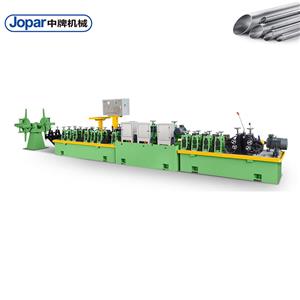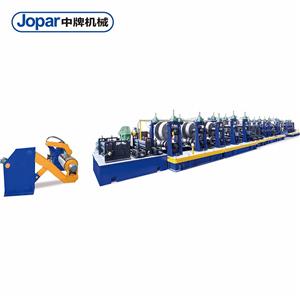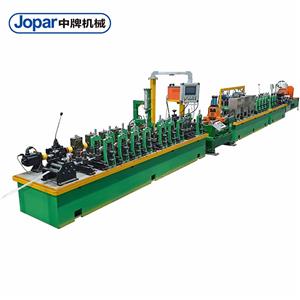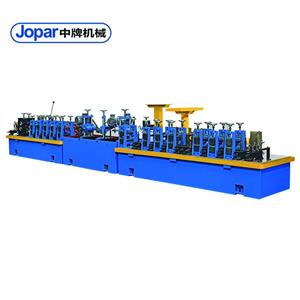
Why Upgrade to an Aluminum Alloy Tube Making Machine?
Why upgrade to an aluminum alloy tube making machine? Because your current production line is silently bleeding money through scrap, downtime, and inconsistent quality. In the competitive world of HVAC, automotive, and structural tubing, precision and speed are non-negotiable. This article, brought to you by Foshan Jopar Machinery Co., Ltd, dives deep into the hidden costs of outdated equipment and shows how modern technology transforms your bottom line.
Let's face it: every production manager knows that sinking feeling when a batch of tubes comes out with hairline cracks or wall thickness variations. It's not just wasted material; it's delayed shipments, rushed rework, and strained client relationships. The traditional tube mill might still run, but it's a liability. We've seen it too many times.
Pain Point 1: Inconsistent Wall Thickness and Ovality
Picture this: you're running a high-volume order for a major automotive supplier. Your old machine, with its worn-out rollers and imprecise cooling system, produces tubes that deviate by 0.15mm in wall thickness. That might not sound like much, but in precision applications, it's a death sentence. The result? 15% of your output gets rejected. That's 15% of your raw material cost, plus the labor, energy, and machine time, all going to scrap. Over a year, that's six figures in losses, not to mention the overtime to re-run the order.
Pain Point 2: High Scrap Rate During Changeover
Another headache: changeover. Every time you switch from one diameter to another, you lose 30-45 minutes of production time, and during that time, you generate a significant amount of off-spec tubing. For a plant running 20 changeovers a month, that's 10-15 hours of downtime and hundreds of pounds of scrap. It's a hidden tax on flexibility, making it impossible to accept small, high-margin orders.
Pain Point 3: Inefficient Energy Consumption and High Maintenance Costs
Then there's the energy bill. Older machines use inefficient motors and heating systems, consuming up to 20% more electricity per ton of output. Plus, the constant breakdowns. Each emergency repair costs an average of $3,000 in parts and labor, and you lose a full day of production. Multiply that by the 10 breakdowns you have each year, and you're looking at $30,000 in direct costs, plus the opportunity cost of lost orders.
Solution 1: Precision Control with Servo-Driven Systems
Modern aluminum alloy tube making machines, like those from Foshan Jopar Machinery Co., Ltd, employ closed-loop servo controls and laser gauging. The result? Wall thickness consistency within ±0.05mm, and ovality under 0.1%. This isn't just a number; it means your reject rate drops from 15% to less than 1%. For a plant producing 10,000 tons a year, that's an extra 1,400 tons of saleable product, translating to millions in additional revenue.
Solution 2: Quick-Change Tooling and Automated Setup
Our machines feature quick-change tooling with preset parameters. Changeover time is reduced from 45 minutes to under 10 minutes. The system automatically adjusts roller positions, welding speed, and cooling rates based on the new product recipe. This not only cuts scrap during changeover but also allows you to accept smaller orders profitably. In fact, one client reported a 50% increase in order acceptance after upgrading.
Solution 3: Energy-Efficient Drives and Predictive Maintenance
We integrate energy-efficient servo motors and high-frequency induction welders that reduce power consumption by up to 25%. Additionally, our machines come with IoT-enabled predictive maintenance. Sensors monitor vibration, temperature, and wear, alerting you before a failure occurs. This reduces unplanned downtime by 70% and cuts maintenance costs by half. The return on investment is typically under 18 months.
Customer Success Stories
Let's look at real examples. First, in Texas, USA, a manufacturer of aluminum tubing for HVAC applications, let's call him Mark Johnson, faced a 12% scrap rate. After installing our model JPM-80, his scrap rate dropped to 0.8% within three months. He said, "The precision is unbelievable. We've reduced our material costs by $400,000 annually."
Second, in Stuttgart, Germany, a supplier of automotive structural parts, led by procurement manager Hans Weber, struggled with changeover times. They switched to our JPM-120 with quick-change tooling. Changeover went from 40 minutes to 8 minutes. Hans noted, "We now handle 30% more order variations without adding shifts. The flexibility is a game-changer."
Third, in Ontario, Canada, a company producing irrigation tubing, owner Sarah Thompson, saw her energy bills soar. After upgrading to our energy-efficient model, her electricity consumption per ton dropped by 22%. She commented, "The savings on energy alone paid for the machine in two years. Plus, fewer breakdowns mean we meet every deadline."
Fourth, in Melbourne, Australia, a manufacturer of aluminum scaffolding, director David Chen, had frequent downtime. With our predictive maintenance system, his unplanned downtime fell by 65%. He said, "The machine tells me when it needs attention. It's like having a maintenance team on board 24/7."
Fifth, in the UK, a producer of precision medical tubing, engineer Emma Wilson, needed extreme accuracy. Our machine achieved wall thickness tolerance of ±0.03mm, exceeding her requirements. She said, "We've expanded our product line into high-end applications, thanks to the reliability of Jopar's equipment."
Applications and Partnerships
These machines are used in a variety of sectors: automotive (for radiator and condenser tubes), HVAC (for refrigeration lines), construction (for structural frames), and even aerospace (for lightweight components). Foshan Jopar Machinery Co., Ltd has established long-term partnerships with major distributors in Europe, North America, and Southeast Asia. For instance, we are the exclusive equipment supplier for a leading German tube manufacturer's expansion in Poland. Our machines are also integrated into the production lines of a Fortune 500 HVAC company in Mexico. These partnerships underscore our commitment to quality and after-sales support.
FAQ
Q1: What is the maximum production speed for your aluminum alloy tube making machine? Our machines can run at speeds up to 120 meters per minute for thin-wall tubes (0.5-2mm). For thicker walls, speeds are adjusted to ensure consistent welding and cooling. The exact speed depends on the alloy and wall thickness, but we guarantee a 20% increase in throughput over conventional machines.
Q2: How do you ensure the weld seam quality is consistent? We use high-frequency induction welding with a patented seam tracking system. The system continuously monitors the weld temperature and adjusts power in real-time. Additionally, we incorporate a 100% eddy current testing station that detects any discontinuities, ensuring every tube meets ASTM B221 standards.
Q3: Can you customize the machine for special alloy compositions like 6061 or 7075? Absolutely. Our machines are designed with a robust heating and cooling control system that can handle a wide range of aluminum alloys. We adjust the annealing temperature profile and quench rate based on the alloy. For 7075, we recommend a slower cooling rate to avoid stress cracking. We provide a complete process recipe library for over 30 alloys.
Q4: What is the typical lead time for a new machine? Standard models have a lead time of 3-4 months from order. Customized machines, with special tooling or automation, take 5-6 months. We also offer a fast-track option for urgent orders, reducing lead time to 8 weeks, but this is subject to production schedule.
Q5: What kind of training and after-sales support do you provide? We include a 5-day on-site training for your operators and maintenance staff. Our support team is available 24/7 via remote diagnostics. We also stock spare parts in our regional warehouses in Houston, Rotterdam, and Shanghai, ensuring 95% of parts are delivered within 48 hours. Additionally, we offer a 2-year warranty on all components, which is extendable.
Conclusion
Upgrading to a modern aluminum alloy tube making machine isn't just about replacing old equipment; it's about transforming your production efficiency, product quality, and profitability. The pain points of inconsistency, slow changeover, and high maintenance are resolved with precision engineering, smart automation, and energy efficiency. Foshan Jopar Machinery Co., Ltd has a proven track record of delivering machines that pay for themselves in under two years. If you're ready to take the next step, download our comprehensive technical white paper below or contact our sales engineers for a personalized ROI analysis. Your competition is already upgrading; don't be left behind.