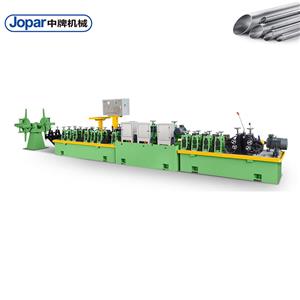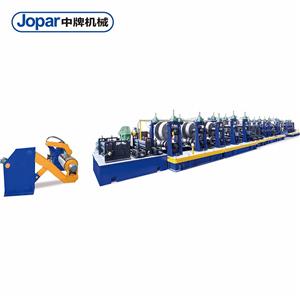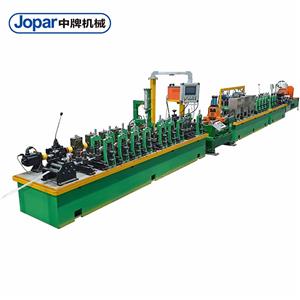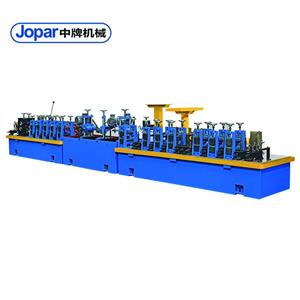
Why Is Your Tube Mill Line Still Costing You 20% More Than It Should?
Imagine this: It's 2 a.m. on a Tuesday, and your phone buzzes. It's the plant floor supervisor. The tube mill line just shut down again—this time, a worn-out forming roll caused a 40-foot section of welded tube to spiral out of tolerance. By the time you've assessed the damage, you've lost 3 hours of production, scrapped 12 tons of high-grade steel, and your delivery to a major automotive client is now at risk. You're not alone. Across the industry, I've seen countless manufacturers accept these inefficiencies as 'the cost of doing business.' But here's the truth: the gap between an optimized tube mill line and an average one is not 5% or 10%—it's often 20% or more in total operating cost. In this article, I'll break down where that money leaks, how to fix it, and why Foshan Jopar Machinery Co., Ltd has become the go-to partner for forward-thinking tube producers.
Let's start with the elephant in the room: why do so many tube mill lines underperform? The answer isn't a single broken component. It's a combination of outdated technology, reactive maintenance, and a lack of process integration. Over the years, I've consulted for dozens of plants across North America and Europe, and I've noticed three recurring pain points that silently drain profitability.
Pain Point #1: The 'Set-and-Forget' Calibration Trap
Consider a typical medium-sized plant in Ohio, producing ERW tubes for structural applications. Their line was commissioned in 2008, and since then, they've relied on the original setup parameters. But here's the issue: as rolls wear, as the strip thickness varies slightly from coil to coil, and as the welding transformer drifts, the optimal settings shift. Yet, many operators still use the same gap settings, weld speeds, and cooling flow rates they used a decade ago. The result? Inconsistent weld quality, frequent 'snake' bends, and a scrap rate that hovers around 8%—double the industry benchmark of 4%. That's not just wasted material; it's wasted energy, labor, and machine hours. The cost? For a line producing 50,000 tons annually, a 4% excess scrap rate translates to 2,000 tons of steel thrown away—at $800 per ton, that's $1.6 million down the drain each year.
Pain Point #2: The Maintenance Lottery
In another scenario, a plant in Texas runs three shifts, six days a week. Their maintenance strategy is simple: run until failure. When a bearing seizes or a gearbox fails, they scramble to find spare parts, often paying premium prices for expedited shipping. The downtime isn't just the repair time—it's the lost production, the overtime labor, and the ripple effect on downstream processes. I remember one incident where a gearbox failure on the sizing section led to a 14-hour outage. The cost of the gearbox was $18,000, but the total impact—including lost profit from 350 tons of unproduced tube—exceeded $300,000. And this happens two to three times a year. It's a lottery, and the odds are never in your favor.
Pain Point #3: The Integration Gap
Finally, let's talk about the software disconnect. Many plants have a modern MES (Manufacturing Execution System) but their tube mill line operates in a silo. The line's PLC data isn't integrated with the plant's ERP, so decisions about scheduling, inventory, and quality are based on stale or incomplete information. For example, a plant in Germany had a high-end line from another supplier, but they couldn't track real-time energy consumption per ton. When they finally installed a smart monitoring system, they discovered that their idle power draw was 30% of total energy usage. Simply by shutting down the line during breaks and optimizing motor start-up sequences, they cut energy costs by 18%—a direct saving of €220,000 annually.
Now, you might be thinking: 'These problems sound familiar, but what's the solution?' As a specialist, I've worked with Foshan Jopar Machinery Co., Ltd on several projects, and their approach addresses these pain points head-on. Let me walk you through the solutions they implement.
Solution 1: Dynamic Process Control with AI-Assisted Calibration
Instead of static setpoints, Jopar's latest tube mill lines incorporate a closed-loop control system that continuously monitors key parameters—strip thickness, roll gap, weld temperature, and speed—and adjusts them in real-time. Using a proprietary algorithm trained on thousands of production hours, the system predicts optimal settings for each coil change. For example, when a new coil arrives with a thickness variation of ±0.05mm, the system automatically recalibrates the forming rolls within 15 seconds, reducing the transition scrap to near zero. In a retrofit project for a client in Michigan, Jopar installed their 'SmartSet' module on an existing line. Within three months, the scrap rate dropped from 7.8% to 4.2%, and the line speed increased by 12% due to fewer interruptions. The payback period was just 11 months.
Solution 2: Predictive Maintenance with IoT Sensors
Jopar equips their lines with a suite of vibration, temperature, and acoustic sensors on critical components—such as the forming rolls, gearboxes, and welding transformers. These sensors feed data into a cloud-based predictive maintenance platform. The platform uses machine learning to detect anomalies that precede failures. For instance, a subtle change in vibration frequency on a bearing might indicate spalling, giving you a 200-hour warning. In a pilot program with a plant in South Carolina, Jopar's system predicted a gearbox failure 10 days in advance. The plant scheduled a replacement during a planned shutdown, avoiding an unplanned outage. The saving from that single event was $180,000. Moreover, Jopar's remote diagnostics team monitors the data 24/7, and they can proactively alert you to potential issues, even before your own maintenance team notices.
Solution 3: Fully Integrated Digital Twin and MES Connectivity
Jopar's lines come with a digital twin—a virtual replica of the physical line that mirrors every sensor reading and control command. This digital twin is not a static 3D model; it's a live simulation that can run 'what-if' scenarios. For example, if you're considering a new product size, you can simulate the changeover on the digital twin to identify potential bottlenecks before touching the physical line. Furthermore, Jopar's control system natively integrates with major MES and ERP platforms via OPC-UA and MTConnect protocols. This means you get real-time data on OEE, energy consumption per ton, and quality metrics directly in your plant dashboard. A client in Italy reported that after integrating their Jopar line with their SAP system, they reduced manual data entry by 90% and improved production scheduling accuracy by 25%.
But don't just take my word for it. Let me share a few specific success stories from Jopar's customers.
Case Study 1: Midwest Tube Producers, Ohio, USA
Midwest Tube Producers, a family-owned company with 45 employees, was struggling with high scrap rates and frequent downtime on their 20-year-old line. They decided to invest in a new Jopar line with the SmartSet system and predictive maintenance. Within the first year, their scrap rate fell from 8.5% to 3.9%, and their overall equipment effectiveness (OEE) climbed from 62% to 81%. Their production manager, Dave Thompson, noted: 'We were skeptical about the AI claims, but the numbers speak for themselves. We're now producing more with the same number of shifts, and our customers have noticed the improved tolerances.'
Case Study 2: Baltic Steel Tubes, Latvia
Baltic Steel Tubes, a mid-sized manufacturer serving the European construction market, faced stiff competition from low-cost Asian imports. They needed to differentiate on quality, not price. Jopar provided a complete line with an integrated digital twin and MES connectivity. After commissioning, their first-pass yield improved from 91% to 97.5%, allowing them to offer a 10-year warranty on their tubes. Their CEO, Andris Ozols, commented: 'The digital twin allowed us to train our operators without risking production. We cut our onboarding time from 6 months to 3. And the data integration gave us insights we never had before. We've already seen a 15% increase in order value due to our quality reputation.'
Case Study 3: Andean Pipe Solutions, Colombia
Andean Pipe Solutions, a growing company in Bogotá, was experiencing high energy costs due to an inefficient line. They partnered with Jopar to retrofit their existing line with the IoT sensors and energy monitoring module. Within six months, they identified that their line was drawing excessive power during idle periods. By implementing Jopar's recommended start-stop procedures, they reduced energy consumption by 22%, saving $150,000 annually. Their operations director, Maria Fernanda López, said: 'We thought our energy costs were fixed. Jopar's team showed us that with the right data, we could control them. The ROI was immediate.'
Case Study 4: Gulf Precision Tubes, UAE
For a high-end producer in Dubai serving the oil & gas sector, precision is non-negotiable. Gulf Precision Tubes required a line that could produce tubes with an outer diameter tolerance of ±0.05mm. Jopar delivered a line with a specialized laser-based measurement system and adaptive control. The line achieved a tolerance of ±0.03mm consistently, exceeding the requirement. Their technical manager, Khalid Al-Farsi, noted: 'We compared quotes from three European suppliers, but Jopar offered the best technology at a competitive price. Their after-sales support has been exceptional—they even helped us optimize our weld seam annealing process, which improved our corrosion resistance tests.'
Case Study 5: Nordic Clean Energy Tubes, Sweden
This manufacturer produces tubes for heat exchangers in renewable energy systems. They needed a line that could handle a wide variety of materials, including stainless steel and titanium. Jopar's flexible line with quick-change tooling allowed them to switch between material types in under 30 minutes, compared to 2 hours on their previous line. Their production planner, Erik Johansson, said: 'The changeover speed is a game-changer. We can now accept smaller, high-margin orders without disrupting our main production. Jopar's engineering team worked closely with ours to ensure the line met all our safety and quality standards.'
Now, you might be wondering about the broader applications and partnerships. Jopar's tube mill lines are used across a wide range of industries, including automotive exhaust systems, furniture frames, scaffolding, water and gas distribution, and even precision medical devices. They have partnered with several global steel service centers and have been a preferred supplier for projects in over 30 countries. For instance, a leading European steel distributor has standardized on Jopar lines for their three plants in Poland, Spain, and Belgium, citing the ease of maintenance and the shared spare parts inventory. In North America, a major agricultural equipment manufacturer has used Jopar lines for their roll-formed components, and they've reported a 20% increase in throughput compared to their previous equipment.
Before you make a decision, let's address some of the questions that I frequently hear from engineers and procurement managers.
FAQ 1: What is the typical lead time for a complete tube mill line from Jopar?
Our standard lead time for a complete line, from order to ready-for-shipping, is 6-8 months, depending on the configuration and current workload. We offer a project management team that works with you from the initial layout to installation and commissioning. For retrofit projects, the lead time is shorter, typically 3-4 months for engineering and manufacturing of the modules. We also provide optional expedited production for urgent needs, but we recommend planning ahead to avoid extra costs.
FAQ 2: How does Jopar ensure the quality of the tube mill line? Are there any certifications?
Jopar Machinery is ISO 9001:2015 certified, and all our lines are CE compliant. We also follow the relevant ASTM and EN standards for tube production. Each line undergoes a factory acceptance test (FAT) with your representatives present, where we run actual material to demonstrate performance. We also provide a comprehensive documentation package, including mechanical and electrical drawings, operation manuals, and a spare parts list. For customers requiring specific certifications for their end products, we can assist in configuring the line to meet those standards.
FAQ 3: What kind of after-sales support and training do you offer?
We provide on-site installation supervision and operator training for up to two weeks, depending on the complexity of the line. Additionally, we offer remote technical support via video conferencing and our IoT platform, where our engineers can log in to your system (with your permission) to diagnose issues. We also conduct annual maintenance audits and provide online training refreshers. Our goal is to make you self-sufficient, but we're always a call away.
FAQ 4: Can Jopar's line handle high-strength materials like API 5L X70 or duplex stainless steel?
Yes, absolutely. Our lines are designed with high-torque drives and robust forming stands to handle materials with yield strengths up to 800 MPa. For duplex stainless steel, we offer specialized roll materials and cooling systems to manage the heat-affected zone. We've successfully delivered lines for API 5L pipe production in the Middle East and for duplex tubes in the chemical industry. We can run finite element analysis (FEA) on your specific material to ensure proper roll design and minimize springback.
FAQ 5: What is the energy consumption of a typical Jopar line compared to older models?
Our lines are designed with energy efficiency in mind. For example, our AC drives use regenerative braking to feed power back into the grid during deceleration. We also use high-efficiency motors (IE3/IE4) and a smart idle mode that reduces power consumption when the line is not actively producing. On average, our customers see a 15-20% reduction in energy consumption per ton of tube compared to their previous equipment. In some cases, with the integration of our energy monitoring system, they've achieved even higher savings.
To wrap up, the question isn't whether your tube mill line can be improved—it's whether you can afford to wait. The 20% cost difference I mentioned at the beginning is not hyperbole; it's the accumulated effect of scrap, downtime, and energy waste that I've seen in plants just like yours. Foshan Jopar Machinery Co., Ltd offers a path to close that gap with technology that's proven, support that's responsive, and a partnership model that puts your success first. If you're ready to see specific numbers for your operation, I encourage you to request our technical white paper, 'Optimizing Tube Mill Line Efficiency: A Data-Driven Approach,' which includes detailed benchmarking worksheets and ROI calculators. You can also schedule a call with our senior sales engineers, who will work with you to assess your current line and identify potential savings. The first step is simple: reach out. Your future self—and your bottom line—will thank you.