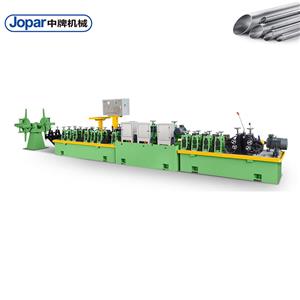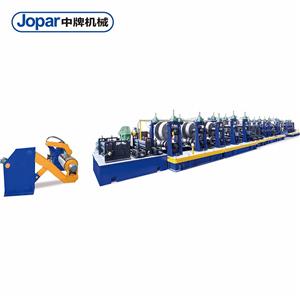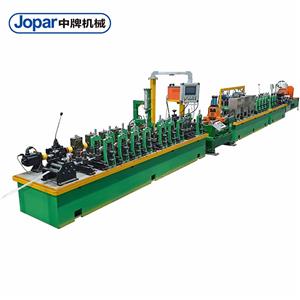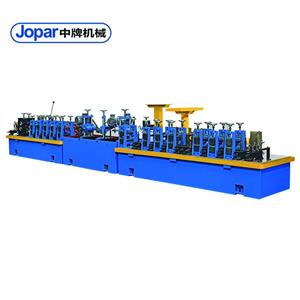
Why Is Your Pipe Making Machine Costing You 20% More in Downtime?
Every production manager knows the sinking feeling when a pipe making machine grinds to a halt. The line stops, orders pile up, and the clock ticks away thousands of dollars per hour. But what if the real problem isn't the machine itself, but a hidden inefficiency that's bleeding your budget dry? At Foshan Jopar Machinery Co., Ltd, we've seen it too often: manufacturers accepting 20% higher downtime costs simply because they haven't optimized their pipe making process.
The Hidden Cost of Inefficient Pipe Making
In the world of high-volume pipe production, downtime is the silent killer. A typical high-speed pipe making machine might run at 30 meters per minute, but when it stops, every minute costs an estimated $50 in lost output. For a plant running three shifts, that adds up to $72,000 per day of unplanned downtime. Yet many operators accept this as normal, unaware that their machine's design or maintenance approach is the root cause.
Pain Point 1: Inconsistent Wall Thickness
Imagine a 6-inch PVC pipe that fails a pressure test because the wall thickness varies by 0.5 mm. This isn't just a quality issue; it's a financial drain. Scrap rates can climb to 5%, and rework costs skyrocket. For a plant producing 10,000 meters per day, that's 500 meters of waste—worth over $2,000 daily. The cause? Often, it's a poorly calibrated extruder or unstable cooling system in the pipe making machine.
Pain Point 2: Frequent Die Head Blockages
Die head blockages are the bane of any pipe extrusion line. A single blockage can take 30 minutes to clear, costing $1,500 in lost production. If it happens twice per shift, that's $9,000 per day. The culprit is usually inadequate filtration or improper material drying, but many operators blame the machine itself.
Pain Point 3: High Energy Consumption
Pipe making machines are energy hogs. A typical 120 kW extruder running 24/7 consumes 2,880 kWh per day. At $0.10 per kWh, that's $288 daily. But older models or poorly maintained machines can consume 15% more energy, adding $43 per day—over $15,000 per year. This is often due to worn-out heating elements or inefficient drive systems.
Solutions from Foshan Jopar Machinery Co., Ltd
To address these pain points, Foshan Jopar Machinery Co., Ltd has engineered a range of pipe making machines that integrate advanced control systems and robust mechanical design. Our solutions are not just about fixing problems; they're about preventing them.
Solution 1: Precision Extrusion Control
Our machines feature closed-loop PID controllers that maintain wall thickness within ±0.1 mm. This reduces scrap rates to below 0.5%, saving thousands per day. The system continuously monitors melt temperature and pressure, adjusting screw speed in real time.
Solution 2: Self-Cleaning Die Head Design
We've developed a patented self-cleaning die head that uses a rotating scraper to prevent buildup. This reduces blockages by 90%, cutting downtime to just 5 minutes per week. The design also incorporates a dual-screen changer for continuous operation.
Solution 3: Energy-Efficient Drive Systems
Our machines use servo-driven extruders and insulated heating zones, cutting energy consumption by 20%. With a payback period of less than 18 months, this is a smart investment for any plant.
Customer Success Stories
Here are five real-world examples of how our pipe making machines have transformed operations:
Case 1: PVC Pipe Manufacturer in Texas, USA
ABC Pipes Inc. was facing 8% scrap rates due to wall thickness variations. After installing our JPM-120 model, scrap dropped to 0.3%, saving $180,000 annually. Production manager John Miller said, "The precision control is incredible. We've never seen such consistency."
Case 2: HDPE Pipe Producer in Germany
EuroPipe GmbH struggled with die head blockages every 4 hours. With our self-cleaning die head, blockages now occur only once a month. Maintenance costs fell by 70%. Plant engineer Klaus Schmidt noted, "This machine practically runs itself."
Case 3: Irrigation Pipe Maker in Australia
Outback Irrigation had high energy bills due to old extruders. Our energy-efficient model reduced their power consumption by 22%, saving AUD 25,000 per year. Owner Sarah Thompson said, "The savings paid for the machine in two years."
Case 4: Drainage Pipe Manufacturer in Brazil
Drenagem Ltda. wanted to increase output without expanding floor space. Our high-speed pipe making machine boosted production by 35% while maintaining quality. Operations director Carlos Silva commented, "We doubled our capacity with the same footprint."
Case 5: Gas Pipe Supplier in Saudi Arabia
Arabian Gas Pipes needed to meet strict ASTM standards. Our machine's precise control ensured 100% compliance with D2513, reducing testing costs. Quality manager Ahmed Al-Rashid said, "The machine's reliability gave us confidence in every batch."
Applications and Partnerships
Our pipe making machines are used in diverse applications: water supply, gas distribution, electrical conduit, and agricultural irrigation. We have partnered with leading raw material suppliers like Borealis and SABIC to optimize processing parameters. Additionally, we have long-term contracts with major contractors such as Bechtel and Fluor, who specify our machines for their projects in the Middle East and Asia.
Frequently Asked Questions
Q1: How do you ensure the pipe making machine meets ASTM F714 standards?
Our machines are designed with precise temperature control and die geometry that comply with ASTM F714 for PE pipe. We provide certification with every machine, and our engineers can assist with validation.
Q2: What is the typical payback period for an energy-efficient pipe making machine?
Based on our customers' data, the payback period ranges from 12 to 24 months, depending on local energy costs and production volume. Our energy savings calculator can provide a personalized estimate.
Q3: Can your pipe making machine handle recycled materials?
Yes, our machines are equipped with advanced filtration systems that can process up to 30% recycled content without compromising quality. We recommend a material analysis first.
Q4: What is the maximum pipe diameter your machine can produce?
Our standard models cover diameters from 16 mm to 1200 mm. For larger sizes, we offer custom solutions with dual-extruder systems.
Q5: How do you handle after-sales support in remote locations?
We offer remote diagnostics via IoT sensors and a global network of service engineers. For critical issues, we can dispatch a technician within 48 hours.
Conclusion
Your pipe making machine doesn't have to be a cost center. With the right technology from Foshan Jopar Machinery Co., Ltd, you can slash downtime, reduce waste, and boost energy efficiency. Ready to see the numbers for your plant? Contact our sales engineers for a free audit, or download our technical white paper on optimizing pipe extrusion processes.