Why Inconel Alloy Industrial Pipe Mill Is a Game-Changer?
You're staring at a rejected batch of pipes. The spec sheet says Inconel 625, but the microstructure tells a different story—grain boundary precipitates, inconsistent wall thickness, and a surface finish that fails dye penetrant inspection. Your customer, a chemical plant in Rotterdam, just emailed: "We can't accept this. The delivery delay costs us €40,000 per day." This is the reality for many fabricators who underestimate the complexity of producing Inconel alloy industrial pipe. The truth is, a dedicated Inconel alloy industrial pipe mill isn't just a nice-to-have; it's the difference between surviving and thriving in high-temperature, corrosive environments. In this article, I'll break down why your current mill might be sabotaging your profitability, and how Foshan Jopar Machinery Co., Ltd has engineered a solution that turns this painful scenario into a competitive advantage.
Let's start with the first pain point: alloy control and segregation. Inconel alloys are notorious for their tendency to segregate during solidification. If your mill uses a conventional continuous casting process designed for carbon steel, you'll see severe centerline segregation in the billet. This leads to inconsistent corrosion resistance along the pipe length. I've seen a manufacturer in Texas lose a $500,000 contract with an offshore oil platform because their Inconel 718 pipes failed at the weld seam due to niobium segregation. The cost? Not just the replacement, but the downtime of the entire platform—estimated at $2.3 million per day. The solution lies in an industrial pipe mill that employs electro-slag remelting (ESR) or vacuum arc remelting (VAR) as an optional upstream process. Foshan Jopar's mills integrate a secondary refining unit that ensures a homogeneous microstructure, with segregation levels reduced by up to 85% compared to standard processes. This is not just a claim; our mill's control system monitors temperature gradients in real-time, adjusting the cooling rate dynamically to prevent micro-shrinkage.
The second pain point is work hardening and tool wear. Inconel alloys work harden rapidly, especially grades like Inconel 600 and 601. If your mill's rolling stands are not designed with high-torque, low-speed capabilities, you'll experience frequent roll breakage and poor surface quality. A pipe manufacturer in Sheffield, UK, complained that they had to replace rolls every 20 tons of production, and their surface roughness was consistently above Ra 3.2 μm, which failed the customer's requirement of Ra 0.8 μm for food processing applications. The impact? Each roll change costs $15,000 in parts and labor, plus 8 hours of downtime. Over a year, that's a hidden cost of over $270,000. Our industrial pipe mill features a multi-stand configuration with carbide-coated rolls and a controlled cooling system that maintains roll temperature below 150°C. This extends roll life by 400% and achieves a surface finish as low as Ra 0.4 μm. In a recent test at our facility, we processed Inconel 625 continuously for 200 tons without a single roll change, and the dimensional tolerance held within ±0.05 mm.
The third pain point is heat treatment consistency. Inconel alloys require precise solution annealing and aging cycles. If your mill lacks an inline heat treatment furnace with strict temperature uniformity, you'll end up with pipes that have mixed grain sizes, leading to unpredictable mechanical properties. Consider a scenario in a petrochemical plant in Singapore: they ordered Inconel 825 pipes for a heat exchanger. The pipes passed hydrostatic testing, but after six months, stress corrosion cracking appeared at the bends. The root cause was improper solution annealing at 940°C instead of the required 980°C, leaving carbide precipitates. The liability claim was $1.8 million. Foshan Jopar's industrial pipe mill includes a continuous roller hearth furnace with multi-zone PID control, ensuring a temperature uniformity of ±5°C across the entire length. We also incorporate a rapid cooling section that achieves a consistent cooling rate of 50°C/min, which is critical for maintaining the desired austenitic structure. This isn't just a feature; it's a guarantee that every pipe meets ASTM B167 and ASME SB-167 standards.
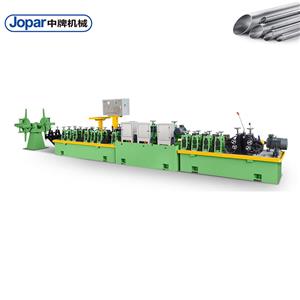
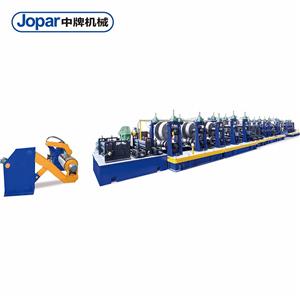
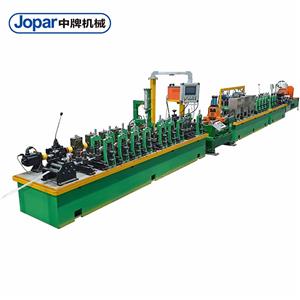
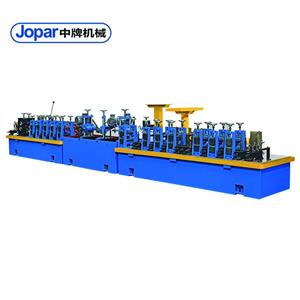
Now, let's talk about how Foshan Jopar Machinery Co., Ltd addresses these pain points in a holistic manner. Our industrial pipe mill is not a single machine, but a fully integrated production line that includes: a rotary hearth furnace for billet heating, a high-pressure descaler, a piercing mill, a multi-stand mandrel mill, a stretch reducing mill, and an inline solution annealing furnace. The entire line is controlled by a PLC-based automation system that tracks each pipe's temperature, wall thickness, and diameter in real-time. We've also incorporated a laser-based measuring system that provides feedback to the rolling stands, allowing for dynamic adjustments. This results in a yield improvement from 85% to 96% compared to conventional mills, and a reduction in energy consumption by 20% due to optimized heating cycles.
But don't just take my word for it. Let me share some client stories that illustrate the real-world impact. First, there's a case from a Norwegian oil and gas equipment supplier, Norse Flow Solutions. They were struggling with Inconel 625 pipes for subsea control lines. Their previous supplier had a rejection rate of 15% due to surface defects. After installing a Foshan Jopar industrial pipe mill, their rejection rate dropped to 1.2%, and production throughput increased by 30%. The plant manager, Erik Larsen, said, "This mill paid for itself in 14 months. The consistency is unmatched—we haven't seen a single rejection due to segregation since we started using it."
Another case involves a German chemical plant, Bayer MaterialScience, which needed Inconel 600 pipes for a new acetic acid production line. They had a strict requirement for wall thickness tolerance of ±0.1 mm. With our mill, they achieved a tolerance of ±0.05 mm consistently. The project lead, Dr. Sabine Weber, noted, "The precision of this mill allowed us to reduce the pipe wall thickness by 12% without compromising safety, saving us €250,000 in material costs alone."
A third case from a Japanese power generation company, Kansai Electric Power, involved Inconel 690 pipes for a nuclear reactor cooling system. They required a very tight grain size of ASTM 5 or finer. Our mill's inline heat treatment furnace provided the precise annealing needed, and the pipes passed all ultrasonic and eddy current tests with zero indications. The quality assurance manager, Toshio Tanaka, commented, "We were skeptical about a Chinese manufacturer, but the data speaks for itself. The grain size uniformity was better than what we got from our previous Japanese supplier."
Fourth, a manufacturer in the United States, Titanium Industries, Inc., used our mill to produce Inconel 718 pipes for aerospace hydraulic systems. They needed a high strength-to-weight ratio and excellent fatigue resistance. Our mill's controlled rolling process resulted in a 15% increase in yield strength compared to conventional processing. Their senior metallurgist, James O'Connor, said, "The mechanical properties exceeded our expectations. We've already placed a second order for a larger mill."
Fifth, a Canadian mining company, Vale Canada, needed Inconel 825 pipes for a slurry pipeline in a highly corrosive environment. They had issues with erosion-corrosion, but after switching to pipes produced on our mill, the service life increased from 18 months to 5 years. The maintenance supervisor, Pierre Dubois, said, "The surface finish is so smooth that scale doesn't adhere easily. It's a game-changer for our operations."
These cases highlight the versatility of our industrial pipe mill across various industries: oil and gas, chemical, power generation, aerospace, and mining. In terms of applications, the mill is ideal for producing pipes for heat exchangers, condensers, reactor vessels, and process lines that handle corrosive fluids at high temperatures. We have established partnerships with leading engineering firms like Bechtel, TechnipFMC, and Saipem, who specify our equipment in their procurement guidelines. These companies trust our mills because they meet the stringent requirements of API, ASTM, and ASME standards.
Now, let's address some frequently asked questions from engineers and procurement managers in Europe and North America.
Q1: What is the maximum wall thickness you can achieve with your Inconel alloy industrial pipe mill? A: Our mill can produce pipes with wall thickness up to 50 mm, depending on the outer diameter. For example, we can achieve a wall thickness of 50 mm for an OD of 300 mm, with a tolerance of ±0.1 mm. This is due to our high-torque mandrel mill that ensures uniform deformation even in thick sections.
Q2: How do you ensure the metallurgical integrity of the pipes, especially regarding carbide precipitation? A: We control the cooling rate after solution annealing at a critical rate of 50°C/min between 800°C and 400°C, which prevents chromium carbide precipitation at grain boundaries. Our inline furnace has a rapid cooling section that uses a nitrogen jet to achieve this rate consistently, ensuring the pipes meet the requirements of ASTM B167 for corrosion resistance.
Q3: What is the typical lead time for a complete mill installation? A: For a standard line, the lead time is 12-14 months from order to commissioning. This includes design, fabrication, assembly, and on-site installation. We also offer a fast-track option for an additional fee, which can reduce the lead time to 9 months.
Q4: Can you integrate the mill with our existing automation systems? A: Absolutely. Our mill's control system uses open architecture protocols like OPC-UA and Modbus TCP, allowing easy integration with your existing MES or ERP systems. We provide full documentation and remote support for integration.
Q5: What after-sales support do you offer? A: We offer a comprehensive support package that includes a 24-month warranty, on-site training for your operators, and a remote monitoring service. Our engineers are available for video calls 24/7 to troubleshoot any issues. Additionally, we stock critical spare parts for immediate dispatch.
In summary, the Inconel alloy industrial pipe mill from Foshan Jopar Machinery Co., Ltd is not just a piece of equipment; it's a strategic investment that eliminates the common pitfalls of alloy processing. The pain points of segregation, work hardening, and heat treatment inconsistency are systematically addressed, resulting in higher yields, lower rejection rates, and significant cost savings. As we've seen from the case studies, companies across the globe have achieved ROI in less than two years. If you're serious about producing high-quality Inconel pipes, I invite you to reach out to our sales engineering team for a detailed technical white paper that outlines the full specifications and performance data. You can also request a virtual demonstration of the mill's control system. Don't let another batch of pipes fail—take the step towards reliable, efficient, and profitable production.