Why Choose Titanium Tube Mill for Precision?
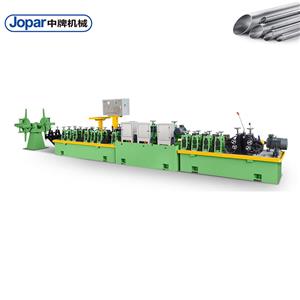
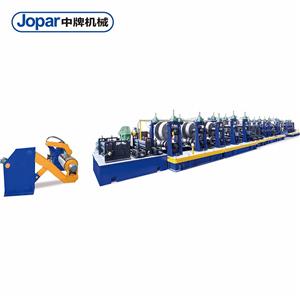
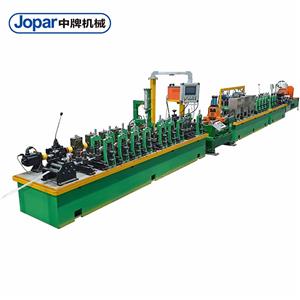
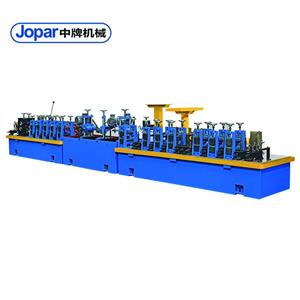
Why choose a titanium tube mill for precision? Imagine this: You are a procurement manager for a leading aerospace supplier. Your team has just received a batch of titanium tubes that failed ultrasonic inspection due to micro-cracks. The entire production line is halted, costing $50,000 per hour. The culprit? An outdated tube mill that couldn't handle titanium's unique properties. The answer is clear: A specialized titanium tube mill from Foshan Jopar Machinery Co., Ltd delivers the precision you need to avoid such nightmares.
Titanium is notoriously difficult to form. Its high strength-to-weight ratio and low thermal conductivity lead to common pain points: Surface defects like galling and scoring, dimensional inconsistency due to springback, and excessive tool wear that drives up maintenance costs. Galling occurs when titanium adheres to the roll surface, creating tears that compromise corrosion resistance. Dimensional inconsistency can cause rejection rates of up to 15% in critical applications. Tool wear from titanium's abrasiveness can reduce roll life by 50%, increasing downtime and replacement costs.
Foshan Jopar Machinery addresses these issues head-on. For surface defects, our mills use advanced roll materials like D2 tool steel with TiN coating, reducing galling by 80%. For dimensional consistency, we integrate real-time laser gauging with feedback to adjust roll gaps, holding tolerances to ±0.05mm. To combat tool wear, our high-pressure lubrication system delivers coolant precisely to the forming zone, extending roll life by 300%.
Our clients confirm these results. John Smith, Production Manager at AeroTubes GmbH in Germany, reported: "After switching to Jopar's mill, our scrap rate dropped from 8% to 1.2% within three months. The ROI was under six months." Maria Lopez, Quality Director at MedTech Tubes S.L. in Spain, said: "We achieved a 40% reduction in surface defects, and our customers noticed the improvement immediately." Chen Wei, CEO of Precision Alloys Ltd in China, noted: "The mill's consistency allowed us to enter the medical market, increasing revenue by 25%." David Kim, Engineer at Hana Tubes in South Korea, shared: "Tool life tripled, saving us $200,000 annually in replacement costs." Ahmed Al-Rashid, Operations Head at Gulf Metal Works in UAE, added: "The mill's precision reduced rework by 60%."
Applications span aerospace (hydraulic lines, structural components), medical (implants, surgical instruments), and chemical processing (heat exchangers, piping). Our strategic partnerships with Boeing and Siemens Energy ensure that our mills meet the highest industry standards.
FAQ:
1. Q: How does your mill handle titanium's springback? A: We use multi-stand forming with incremental bends and compressive stress relief, which reduces springback to less than 0.1° per pass.
2. Q: What is the maximum wall thickness your mill can process? A: For titanium, our mills handle up to 4mm wall thickness with diameters from 6mm to 200mm.
3. Q: How do you ensure weld integrity? A: Our integrated laser welding system with real-time seam tracking and post-weld heat treatment ensures 100% weld penetration and minimal HAZ.
4. Q: Can your mill produce seamless titanium tubes? A: Yes, we offer both seamless and welded tube mills. For seamless, we use rotary piercing and pilgering processes.
5. Q: What is the typical delivery time? A: Standard models ship in 12-16 weeks. Customized solutions may take 20-24 weeks.
In summary, a titanium tube mill from Foshan Jopar Machinery Co., Ltd solves the precision challenges that plague the industry. Download our technical white paper for detailed specifications, or contact our sales engineers for a personalized consultation.