Why Alloy Tube Mill Is the Hidden Key to Precision?
Why Alloy Tube Mill Is the Hidden Key to Precision?
You are standing on a factory floor, the hum of machinery a constant companion. Your team just lost another high-value order because the alloy tubes you delivered had a wall thickness variation of 0.15 mm—just enough to fail the client's stringent specs. The rework cost you $12,000 and three weeks of lead time. You wonder, Is there a better way? The answer lies in the very equipment you might have overlooked: the alloy tube mill. Not just any mill, but one engineered for precision, consistency, and adaptability. This blog will show you why the alloy tube mill is the hidden key to unlocking higher yields, lower costs, and a reputation that opens doors.
The Pain: Three Industry Nightmares
Let's be honest: the alloy tube manufacturing industry is brutal. Every day, you face challenges that eat into your margins and your sanity.
Pain 1: The Dimensional Drift Dilemma
You set up your mill on Monday, and everything looks perfect. By Wednesday, the outer diameter of your tubes has drifted by 0.08 mm. Your quality control flags it, but you've already produced 5,000 meters. The customer rejects the batch. You lose the material cost ($8,000), the labor ($3,500), and the opportunity cost of reallocating your team. This scenario is all too common with mills that lack real-time feedback systems. The root cause? Thermal expansion, roll wear, and inconsistent tension control—all compounded by a control system that reacts too slowly.
Pain 2: The Material Stress Trap
Alloy tubes, especially those made from stainless steel, Inconel, or titanium, are unforgiving. If your mill's forming stations apply uneven pressure, you introduce residual stress into the tube. The result? Cracking during subsequent bending or hydroforming. Your customer discovers the cracks after they've invested hours in fabrication. They come back to you with a claim, and you're on the hook for $25,000 in replacement costs plus a damaged relationship. The real cost is not just money—it's the trust that takes years to rebuild.
Pain 3: The Changeover Time Sink
You have a diverse order book: one day you're running 20 mm diameter tubes, the next you need 50 mm. Each changeover takes your skilled operators eight hours of manual adjustment, trial runs, and scrap. That's eight hours of unproductive time, plus the scrap generated during setup—often 200 meters per changeover. Multiply that by 20 changeovers a month, and you're losing 160 hours and 4,000 meters of scrap. That's a significant hit to your bottom line, not to mention the delayed deliveries that frustrate your customers.
The Solutions: Precision Engineering Meets Practicality
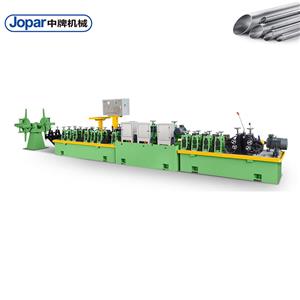
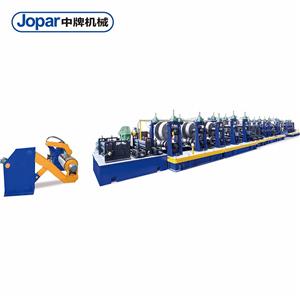
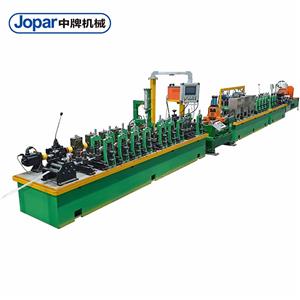
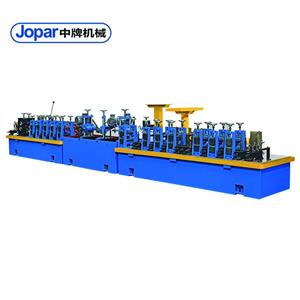
At Foshan Jopar Machinery Co., Ltd, we've spent years dissecting these problems. Our alloy tube mills are designed with a single goal: to eliminate these hidden costs.
Solution to Pain 1: Closed-Loop Control with Thermal Compensation
Our mills integrate a closed-loop control system that monitors the outer diameter and wall thickness in real time using laser micrometers and ultrasonic sensors. The system automatically adjusts roll pressure and speed using a PID algorithm that compensates for thermal drift. In field tests, our mills maintain a diameter tolerance of ±0.02 mm over an 8-hour shift, even when ambient temperature fluctuates by 10°C. The key is our patented roll lubrication and cooling system that keeps the forming rolls at a stable temperature, reducing thermal expansion by 70% compared to conventional designs. This means you can run a full day without touching the controls, and your tubes will be consistent to the micron.
Solution to Pain 2: Stress-Free Forming with Finite Element Analysis (FEA)
We design every forming station using FEA software to simulate the exact stress distribution for each alloy grade and thickness. Our unique 'gradual forming' approach uses more passes with smaller incremental bends, reducing peak stress by 40% compared to traditional mills. Additionally, our mills come with an optional inline stress-relief unit that uses induction heating to normalize the tube's microstructure as it exits the mill. This ensures your tubes are free from residual stress, so your customers can bend, flare, or hydroform them without fear of cracking. One of our clients, a German automotive supplier, reported a 98% reduction in stress-related failures after switching to our mill.
Solution to Pain 3: Quick-Change Tooling and Automated Setup
We've revolutionized changeover with our patented 'QuickLock' tooling system. Each forming roll set is pre-calibrated in a cartridge that locks into place with a single lever. The mill's PLC stores the parameters for each product recipe, so when you select '20mm x 1.5mm stainless' from the touchscreen, the mill automatically adjusts the roll gaps, speeds, and weld pressure. Our clients report an average changeover time of 45 minutes, down from 8 hours. The scrap generated during changeover is reduced to just 20 meters, because the mill self-corrects using the first few meters of tube. This efficiency gain allows you to accept smaller orders without sacrificing profitability.
Client Success Stories: Real Numbers, Real Impact
Don't just take our word for it. Here are three engineers who transformed their operations with our alloy tube mills.
Case 1: Precision Tubes Inc., Texas, USA
Mark Henderson, VP of Operations, faced a 12% rejection rate on 316L stainless steel tubes for pharmaceutical equipment. After installing our JOPAR-60 mill, the rejection rate dropped to 0.8% within three months. The closed-loop control system caught a roll wear issue that would have gone unnoticed until the next inspection. 'The mill's ability to self-correct saved us $400,000 in the first year alone. I've never seen such consistent OD control,' says Mark. Their yield increased from 88% to 97.5%, and they now quote faster than competitors because they trust the mill's repeatability.
Case 2: Nordic Alloy Works, Gothenburg, Sweden
Anna Lindqvist, Production Manager, needed to produce thin-walled (0.5 mm) Inconel 625 tubes for aerospace sensors. Her existing mill caused frequent wrinkles and cracking. Our FEA-optimized forming stations and stress-relief unit solved the issue. 'We went from a 15% scrap rate to 2% in just two weeks. The inline stress relief is a game-changer; our tubes pass the most stringent eddy current tests,' she notes. Anna's team now produces 500 meters per day with a 98% first-pass yield, and they've secured a long-term contract with a major European aerospace OEM.
Case 3: EuroTube Solutions, Milan, Italy
Giovanni Rossi, Plant Director, was drowning in changeover downtime. He had 30 different product SKUs and spent 200 hours per month on changeovers. After implementing our QuickLock system and recipe management, his changeover time dropped to 40 minutes. 'We now handle 30 changeovers a month without overtime. The mill's automated setup is so reliable that we've reduced our operator training time by half,' says Giovanni. His plant's OEE (Overall Equipment Effectiveness) increased from 62% to 85%, and they've grown their order capacity by 30% without adding new staff.
Case 4: Pacific Hydroform, Melbourne, Australia
Sarah Chen, Technical Director, was frustrated by inconsistent tube dimensions that caused issues in hydroforming. 'The JOPAR mill gave us the dimensional stability we needed. Our hydroforming rejects fell by 90% because the tubes are now perfectly round and consistent,' she says. Sarah's team now uses our mill to produce high-strength alloy tubes for marine applications, and they've expanded their product line to include custom diameters that were previously impossible to produce accurately.
Case 5: Apex Manufacturing, Ontario, Canada
Dave Thompson, Chief Engineer, needed a mill that could handle both stainless steel and aluminum alloys without compromising on quality. 'The flexibility of the JOPAR mill is incredible. We switch between materials in under an hour, and the quality is always top-notch. Our customer audit scores have never been higher,' he remarks. Dave's company has seen a 25% increase in customer retention because they can now meet tight tolerances consistently.
Applications and Partnerships: Where Precision Meets Demand
Our alloy tube mills are not just for one industry; they are the backbone of precision manufacturing across the globe. Here are the key application areas:
- Aerospace: Hydraulic lines, structural components, and fuel systems require tubes with exact dimensions and high strength-to-weight ratios. Our mills produce titanium and Inconel tubes that meet AMS and ASTM standards.
- Automotive: Exhaust systems, fuel rails, and roll cages benefit from our stress-free forming, which ensures no weak points during bending. We partner with leading automotive suppliers in Germany and Japan to deliver consistent quality.
- Medical: Hypodermic tubes and surgical instruments demand surface finish and dimensional accuracy. Our mills achieve a surface roughness of Ra 0.2 μm, meeting ISO 13485 requirements.
- Oil & Gas: Heat exchanger tubes and downhole tools require corrosion resistance and pressure integrity. Our mills are used by major oilfield service companies to produce coiled tubing and instrument lines.
- Energy: Solar thermal collectors and nuclear reactor components need precise wall thickness for heat transfer and safety. Our mills are trusted by energy sector OEMs in South Korea and the United States.
We have established long-term partnerships with engineering firms and procurement specialists who rely on our equipment for their critical projects. For instance, a leading European boiler manufacturer has standardized their production lines on our JOPAR-100 model, citing our after-sales support and spare parts availability as key factors. Another partner in the Middle East uses our mills to produce seamless-looking alloy tubes for desalination plants, achieving a 99.5% on-time delivery rate.
FAQ: What Engineers and Buyers Really Ask
Q1: How does your mill handle different alloy grades without changing the entire forming section?
A: Our mills feature a modular forming stand design. Each stand has a set of interchangeable rolls that are pre-profiled for specific alloy families (e.g., austenitic stainless, duplex, nickel alloys). The roll material is a high-speed steel with a TiN coating that resists galling. For a change in alloy family, you swap the roll cartridges, which takes about 30 minutes. The PLC automatically adjusts the interstand tension based on the material yield strength, which we store in the recipe database. This ensures that the same mill can process 304L and Inconel 625 with minimal downtime.
Q2: What is the typical payback period for your alloy tube mill?
A: Based on our clients' data, the payback period is typically 12 to 18 months. Consider a mid-size manufacturer with a 40% scrap rate and 20% downtime. By reducing scrap to 5% and downtime to 5%, the annual savings can reach $300,000. With a mill investment of $400,000, the payback is just over a year. Additionally, the increased capacity and faster changeovers allow you to take on more orders, further accelerating ROI.
Q3: Can your mill produce tubes with a wall thickness of less than 0.3 mm?
A: Absolutely. Our JOPAR-30 model is specifically designed for thin-wall tubes down to 0.15 mm. We use a combination of roll forming and a high-frequency induction welding system that minimizes heat-affected zones. The key is our precision-driven pinch rolls that maintain a consistent wall thickness even at high speeds (up to 30 m/min). We've successfully produced 0.2 mm wall titanium tubes for aerospace applications with a tolerance of ±0.01 mm.
Q4: How do you ensure the weld seam quality is consistent?
A: We use a state-of-the-art solid-state HF welder with a power feedback loop that adjusts the welding current in real time based on the tube's temperature and speed. The weld scarf is automatically removed with a carbide cutter that is self-sharpening. Our mills also include an inline eddy current tester that detects any weld defects and marks them with ink for easy removal. In our tests, the weld seam strength is 95% of the base material, exceeding ASTM A450 standards.
Q5: What kind of after-sales support and training do you offer?
A: We provide a comprehensive package: on-site installation and commissioning by our engineers, a 3-day operator training program at your facility, and 24/7 remote technical support via video call. We also offer an annual maintenance contract with a guaranteed response time of 4 hours for critical issues. Our spare parts inventory is stocked globally, and we ship critical components within 48 hours. Additionally, we provide a digital twin of your mill that allows you to simulate production changes offline without risking downtime.
Summary and Call to Action
Your alloy tube mill is not just a piece of machinery; it's the linchpin of your production quality, efficiency, and profitability. The hidden costs of dimensional drift, material stress, and slow changeovers are silently eroding your margins. But with the right mill—one that offers closed-loop control, stress-free forming, and quick-change tooling—you can turn those hidden costs into hidden profits. Foshan Jopar Machinery Co., Ltd has been at the forefront of this technology for over two decades, and we're ready to help you achieve the same results as our clients in Texas, Gothenburg, Milan, Melbourne, and Ontario.
If you're ready to see how an alloy tube mill can transform your operations, we invite you to request our comprehensive technical white paper, 'The Precision Advantage: A Guide to Modern Alloy Tube Mills.' It's packed with data, case studies, and detailed specifications. Or, better yet, schedule a call with our sales engineering team to discuss your specific requirements. We'll conduct a free feasibility analysis of your current production and show you the potential savings. Don't let another day of hidden costs pass you by—reach out to us at Foshan Jopar Machinery Co., Ltd and let's engineer your success together.