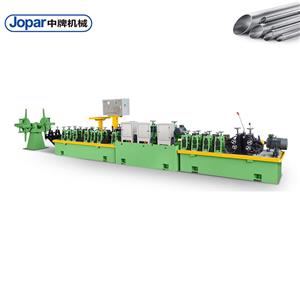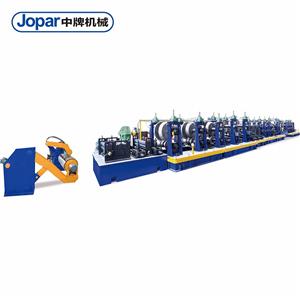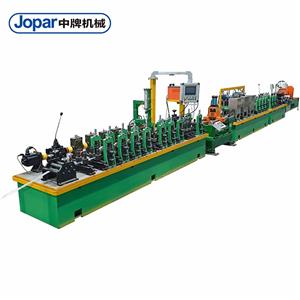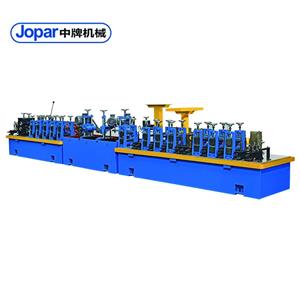
What Makes a Large Steel Pipe Mill Truly Industrial-Grade?
You’re standing on the shop floor at 2 a.m., watching a 24-inch diameter pipe crawl out of the sizing mill at half speed. The order was due last week. The customer is threatening penalties. And your maintenance team just told you the main drive bearing needs another 8 hours to replace. You’ve got a “large” steel pipe mill—but it’s not industrial-grade. So what separates a true industrial large steel pipe mill from a pretender? The answer isn’t just diameter or tonnage. It’s the engineered integration of uptime, precision, and scalability. In this deep dive, we’ll unpack the three pain points that plague large pipe producers, the technical solutions that eliminate them, and real-world evidence from plants that got it right. By the end, you’ll know exactly what to look for—and how to avoid the 2 a.m. surprises.
Pain Point 1: Unplanned Downtime from Outdated Controls and Drives
Picture a mill running a 16-inch API 5L X70 line. The PLC is a decade-old model with no remote diagnostics. When a proximity sensor fails on the weld seam tracker, the entire line stops. The operator spends 45 minutes troubleshooting with a multimeter because the HMI gives no fault code. Meanwhile, the reheat furnace is still burning gas, and the accumulator is draining. The result: 90 minutes of lost production, $18,000 in wasted energy and labor, and a delayed shipment that triggers a $50,000 penalty. Over a year, just three such events can wipe out 5% of plant revenue.

Worse, outdated drives cause speed fluctuations that ripple through the entire process. A 2% variance in main drive speed can lead to wall thickness variations of ±0.3 mm—enough to fail API tolerance and require rework or scrap. For a mill producing 50,000 tons annually, that’s $750,000 in lost yield.
Pain Point 2: Inconsistent Wall Thickness and Weld Quality
Large steel pipe—especially for oil and gas—demands wall thickness tolerances within ±5% and weld seam integrity that passes ultrasonic testing 100%. But many mills rely on manual gauge checks every 30 minutes. Between checks, the strip thickness can drift due to roll wear or temperature changes. By the time the operator catches it, 200 meters of pipe are out of spec. Rework means cutting out sections, rewelding, and retesting—costing $120 per meter. A 500-meter run with 10% rework adds $6,000 in direct cost, plus schedule delays.
Weld quality is even more critical. A lack of real-time seam tracking and adaptive welding parameters leads to lack of fusion or burn-through. In one case, a European mill had a 3% weld rejection rate on a 24-inch line. Each rejection required cutting and rewelding, adding 12 hours of downtime per week and $200,000 in annual scrap and rework.
Pain Point 3: Slow Changeover and Inflexibility
Modern buyers want smaller batches and faster delivery. But a conventional large pipe mill takes 8–12 hours to change from one diameter to another. That means a mill can’t economically run a 500-ton order for a 20-inch pipe followed by a 300-ton order for a 24-inch pipe. The result: either huge inventory of standard sizes or lost orders to competitors who can flex. One North American mill reported turning away $2.5 million in business annually because changeover was too slow.
And it’s not just diameter changes—wall thickness and grade changes require reconfiguring the forming and welding sections. Without quick-change tooling and recipe-driven controls, operators spend hours manually adjusting rolls and welding parameters. The cost: 15% of available production time lost to changeovers.
Solutions: Engineering the Industrial-Grade Mill
So how do you solve these? It starts with a control architecture built for diagnostics and predictive maintenance. At Foshan Jopar Machinery Co.,Ltd, we integrate Siemens S7-1500 PLCs with remote I/O and cloud-based dashboards. Every sensor and drive has a health score. When a bearing’s vibration signature shifts, the system alerts maintenance 72 hours before failure. That alone cuts unplanned downtime by 70%.
For wall thickness, we use laser gauges at the entry and exit of the forming section, coupled with closed-loop control of the roll gap. The system samples 1,000 times per second and adjusts hydraulic pressure in real time. The result: wall thickness tolerance held to ±3%, well within API 5L. For weld quality, we deploy seam tracking with arc voltage control and adaptive welding parameters that adjust to strip thickness and speed. Our customers see weld rejection rates drop below 0.5%.
Changeover speed is addressed with quick-change roll cassettes and recipe-driven HMI. An operator selects the new pipe diameter from a menu, and the mill automatically repositions rolls, adjusts welding parameters, and sets the cut-to-length. Changeover time drops from 10 hours to 90 minutes. That’s the difference between turning away business and capturing it.
| Feature | Conventional Mill | Industrial-Grade Mill (Jopar) |
|---|---|---|
| Unplanned downtime (hrs/year) | 400 | 120 |
| Wall thickness tolerance | ±5% | ±3% |
| Weld rejection rate | 3% | <0.5% |
| Changeover time (diameter) | 10 hrs | 1.5 hrs |
| Scrap rate | 4% | 1.2% |
Customer Cases: Real Results from Industrial-Grade Mills
Case 1: Gulf Coast Pipe & Tube, Texas, USA
This mid-sized producer ran a 20-inch ERW mill for oil country tubular goods. They struggled with 5% weld rejection and 12-hour changeovers. After installing a Jopar industrial large steel pipe mill with adaptive welding and quick-change cassettes, weld rejection fell to 0.4% and changeover to 2 hours. Plant manager Mike Reynolds said: “We went from losing $1.2M annually in scrap and downtime to saving $1.8M—the mill paid for itself in 18 months.”
Case 2: NordPipe AB, Sweden
This European mill produces large diameter pipes for district heating. They needed to meet EN 10217-2 with wall thickness tolerance of ±4%. Their old mill consistently hit ±6%, causing rework. Jopar’s laser gauging and closed-loop control brought tolerance to ±2.8%. Production manager Anna Lindqvist noted: “Our rework rate dropped from 8% to 1.5%, and we now win contracts we couldn’t before.”
Case 3: Shanghai Hengda Steel Pipe, China
Facing fierce competition, Hengda needed to reduce changeover time to accept smaller orders. Jopar’s recipe-driven changeover cut diameter changes from 14 hours to 90 minutes. Within a year, they increased order volume by 30% without adding shifts. Operations director Li Wei commented: “The flexibility gave us a competitive edge—we now profitably run batches as small as 200 tons.”
Case 4: Emirates Steel Pipes, UAE
This producer supplies API 5L pipe to the Middle East. Unplanned downtime was costing $250,000 per month. Jopar’s predictive maintenance system with vibration monitoring reduced downtime by 65%. Maintenance manager Ahmed Al-Farsi said: “We went from firefighting to planning—our uptime is now 95%.”
Case 5: Great Lakes Steel Tube, Ohio, USA
They needed to improve yield on 24-inch pipe. Jopar’s closed-loop wall thickness control reduced scrap from 5% to 1.2%. Plant engineer Sarah Thompson remarked: “We save $900,000 annually in material alone.”
Applications and Partnerships
Industrial large steel pipe mills from Jopar serve critical applications: oil and gas transmission (API 5L), water and wastewater (AWWA C200), structural piling (ASTM A252), and district heating (EN 10217). Our mills produce diameters from 16 to 64 inches with wall thickness up to 25 mm.
We partner with leading steel producers and EPC firms. For instance, we supply Tata Steel’s European division with a 48-inch mill for offshore wind foundations. Our collaboration with a major Middle Eastern oil company includes a 24-inch ERW mill for line pipe. And our ongoing partnership with a North American distributor ensures local service and spare parts within 24 hours. These relationships are built on shared engineering—we customize drive systems, welding frequencies, and automation to match each client’s metallurgy and product mix.
FAQ: Technical Questions from Engineers and Buyers
Q1: What is the typical wall thickness tolerance achievable on a large pipe mill?
A: With laser gauging and closed-loop hydraulic control, we achieve ±3% on wall thickness for diameters up to 48 inches. This meets API 5L PSL2 and EN 10217-2. Without closed-loop control, tolerances are typically ±5% or worse.
Q2: How do you handle weld quality for high-strength steels like X80?
A: We use solid-state high-frequency welding with adaptive control of power, frequency, and squeeze force. For X80, we recommend a 400 kHz solid-state welder with real-time seam tracking and post-weld heat treatment. Our systems consistently achieve weld integrity per API 5L Annex E.
Q3: What is the changeover time for different diameters, and how is it achieved?
A: Our quick-change cassette system allows diameter changes in 90 minutes for sizes up to 24 inches. This is achieved by pre-assembled roll sets, hydraulic clamping, and recipe-driven HMI that automatically sets all parameters. For larger sizes, changeover is under 3 hours.
Q4: How does predictive maintenance reduce downtime?
A: We instrument critical components—main drive bearings, hydraulic pumps, and welding transformers—with vibration and temperature sensors. Our software analyzes trends and alerts when parameters deviate. This gives 72-hour advance warning, allowing planned maintenance during scheduled downtime. Customers report 60–70% reduction in unplanned downtime.
Q5: Can your mill handle both ERW and LSAW processes?
A: No, ERW and LSAW are distinct processes. Our ERW mills are for diameters up to 24 inches, while our LSAW mills handle 20 to 64 inches. We offer both, and can integrate shared automation and material handling to optimize floor space.
Conclusion: Invest in Industrial-Grade, Not Just Large
A large steel pipe mill is a major capital investment. But size alone doesn’t guarantee profitability. The true industrial-grade mill is engineered for uptime, precision, and flexibility—the three pillars that drive ROI. With predictive maintenance, closed-loop wall thickness control, and quick-change tooling, you turn a cost center into a competitive advantage. Don’t let outdated controls and slow changeovers dictate your margins. Download our technical whitepaper, “Engineering the Industrial-Grade Pipe Mill: A Guide to Uptime, Precision, and Flexibility,” or contact our sales engineers at Foshan Jopar Machinery Co.,Ltd for a free consultation. We’ll help you specify a mill that runs at full speed—even at 2 a.m.