What Makes a Large MS Tube Machine Worth the Investment?
Imagine this: you’re a production manager at a metal furniture factory in Ohio. Your team just ran a batch of 2-inch mild steel tubes for a major order. The wall thickness varies by 0.15 mm along the length—enough to cause wobble in the final assembly. You now face rework, delayed shipments, and a frustrated customer. This scenario plays out daily in plants that rely on outdated or undersized tube mills. The question isn’t whether you need a large MS tube making machine—it’s whether you can afford to keep running without one. In this deep dive, we’ll unpack exactly what makes a large MS tube making machine worth the investment, from the technical differentiators to the bottom-line impact. By the end, you’ll have a clear framework to evaluate whether upgrading your line is a cost or a profit engine.
Pain Point 1: Inconsistent Wall Thickness and Weld Quality
Thickness variation is the silent killer of tube production. When a machine lacks rigid forming sections and precise roll tooling, the strip can slip or stretch unevenly. The result? Tubes that fail dimensional checks, causing assembly line jams at your customer’s plant. For a typical 50,000-meter monthly run, even a 5% reject rate translates to 2,500 meters of scrap—costing upwards of $8,000 in material alone, plus labor and downtime. Worse, inconsistent weld seams lead to leaks in HVAC or hydraulic applications, triggering warranty claims and reputational damage.
Pain Point 2: Slow Changeover and Limited Size Range
Many older tube mills require 4–6 hours to switch from one tube diameter to another. If you produce 10 different sizes per week, that’s 40–60 hours of lost production monthly. For a contract manufacturer in Germany serving automotive and construction clients, this flexibility bottleneck means turning down urgent orders or paying overtime. The hidden cost? Approximately €15,000 per month in lost contribution margin, not to mention the risk of missing delivery windows and losing preferred supplier status.
Pain Point 3: High Energy Consumption and Maintenance Downtime
Inefficient drive systems and poorly designed gearboxes waste electricity. A large MS tube making machine that lacks servo-controlled flying cutters and optimized induction welders can consume 30% more power than a modern equivalent. Additionally, frequent breakdowns of the uncoiler or straightener cause unplanned stoppages. In a Southeast Asian plant producing 80,000 meters per month, each hour of downtime costs $1,200 in lost output. Over a year, that’s nearly $300,000—enough to fund a new machine.
Solution 1: Rigid Forming and Precision Roll Tooling
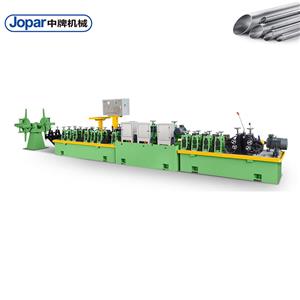
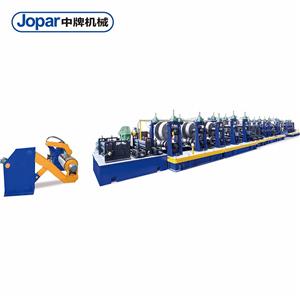
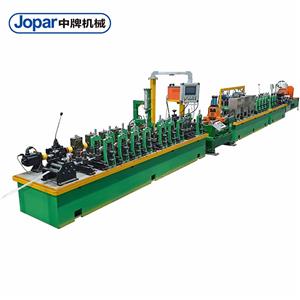
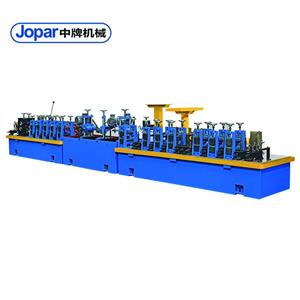
To eliminate thickness variation, leading machines like those from Foshan Jopar Machinery Co.,Ltd employ a closed-loop forming section with individually adjustable roll stands. The rolls are made from high-chromium tool steel, heat-treated to 58–62 HRC, and ground to ±0.01 mm tolerance. This ensures the strip is guided without slippage, maintaining wall thickness within ±0.05 mm. Additionally, a high-frequency induction welder with automatic impedance matching keeps the weld seam consistent, reducing scarf height and internal bead. The result: tubes that pass ultrasonic testing on the first try, cutting scrap by up to 80%.
Solution 2: Quick-Change Systems and Modular Design
Modern large MS tube making machines feature quick-change roll cassettes and hydraulic clamping. A size change from 50 mm to 100 mm square tube can be completed in under 45 minutes by a single operator. This is achieved through a modular architecture where the forming, welding, and sizing sections are independent but synchronized via a PLC. Foshan Jopar Machinery Co.,Ltd designs its machines with a “one-touch” recipe system: the operator selects the tube size on the HMI, and the machine automatically adjusts roll positions, welding power, and cutting length. This flexibility allows manufacturers to accept smaller batch orders profitably, opening new revenue streams.
Solution 3: Energy-Efficient Drives and Predictive Maintenance
By integrating IE4 permanent magnet motors and servo-driven flying cutters, a large MS tube making machine can reduce energy consumption by 25–35%. The induction welder uses solid-state technology with a power factor above 0.95, minimizing reactive power penalties. For maintenance, vibration sensors and thermal cameras monitor critical bearings and gears. Data is fed to a cloud-based dashboard that alerts operators before a failure occurs. In one case, a European tube producer avoided a catastrophic gearbox failure that would have cost $50,000 in parts and 5 days of downtime—simply by acting on a predictive alert.
Customer Success Stories
Case 1: Metalcraft Industries, Ohio, USA
This family-owned fabricator struggled with 7% scrap on 2-inch round tubes. After installing a Jopar large MS tube making machine with a 12-roll forming section, scrap dropped to 0.8%. “We now run 60,000 meters monthly with one operator instead of three,” says plant manager Mike Reynolds. “The payback was under 14 months.”
Case 2: Tubotec GmbH, Stuttgart, Germany
Specializing in automotive structural tubes, Tubotec needed to switch between 15 sizes daily. Their old mill took 5 hours per changeover. With Jopar’s quick-change cassettes, changeover now takes 40 minutes. “We increased our order intake by 22% without adding a second shift,” reports production head Klaus Weber. Annual savings: €210,000.
Case 3: Precision Tubes Ltd., Birmingham, UK
Facing rising energy bills, this HVAC tube maker upgraded to a Jopar machine with IE4 motors and servo cutter. Energy consumption per meter dropped by 31%. “Our monthly electricity bill fell by £4,200,” says managing director Sarah Collins. “The machine paid for itself in 18 months through energy savings alone.”
Case 4: Southeast Asia Steel Pipe, Ho Chi Minh City, Vietnam
This producer of construction tubes was plagued by unplanned downtime. After installing a Jopar line with predictive maintenance, uptime reached 98.5%. “We used to lose 20 hours monthly to breakdowns; now it’s less than 2,” says maintenance manager Nguyen Van Minh. Output increased by 35% without additional labor.
Case 5: Acero del Norte, Monterrey, Mexico
Serving the appliance industry, this company needed tighter tolerances. Jopar’s machine held wall thickness to ±0.04 mm, reducing customer rejects to zero. “We won a contract with a major appliance brand because we could guarantee consistency,” says quality manager Carlos Hernández. “The machine gave us a competitive edge.”
Applications and Partnerships
Large MS tube making machines are indispensable in automotive (exhaust systems, chassis components), furniture (frames, legs), construction (scaffolding, guardrails), HVAC (refrigerant lines), and general engineering (hydraulic cylinders). Foshan Jopar Machinery Co.,Ltd has established long-term partnerships with major steel processors and OEMs across North America, Europe, and Southeast Asia. For instance, a top-tier German automotive supplier sources 80% of its tube mills from Jopar after a rigorous audit of weld quality and repeatability. Similarly, a leading US furniture manufacturer standardized on Jopar machines across three plants, citing their reliability and local service support.
FAQ
Q1: What is the maximum wall thickness a large MS tube making machine can handle?
A: Depending on the model, Jopar machines can process mild steel from 0.5 mm to 6.0 mm wall thickness, with tube diameters from 12 mm to 150 mm. For thicker walls, we recommend a heavy-duty series with increased roll diameter and torque.
Q2: How do you ensure weld quality at high line speeds?
A: We use a solid-state high-frequency welder with automatic frequency tracking and impedance matching. The weld seam is monitored by an infrared pyrometer, and the system adjusts power in real time to maintain the optimal forging temperature. This ensures a consistent weld even at 120 m/min.
Q3: What is the typical lead time and installation support?
A: Standard lead time is 90–120 days. We provide on-site installation, commissioning, and operator training. Our engineers stay until the machine meets agreed performance metrics, such as scrap rate and output.
Q4: Can the machine be integrated with existing cut-off and stacking equipment?
A: Yes. Our control system supports Modbus, Profibus, and Ethernet/IP, allowing seamless integration with your existing downstream equipment. We also offer custom interface panels.
Q5: What maintenance is required to keep the machine running at peak performance?
A: Daily checks include lubrication and roll alignment. Monthly tasks involve checking welder electrodes and drive belts. Our predictive maintenance system alerts you to bearing wear or gearbox anomalies. Annual overhaul kits are available.
Conclusion: Turning a Cost Center into a Profit Engine
A large MS tube making machine is not just a piece of equipment—it’s a strategic asset that directly impacts your scrap rate, energy bill, and ability to win business. By choosing a machine with rigid forming, quick-change capability, and smart maintenance, you transform your tube production from a bottleneck into a competitive advantage. To explore whether a Jopar machine is right for your operation, request our detailed technical white paper or speak with a sales engineer. We’ll help you calculate the ROI based on your specific production data.