Is Your Pipe Welding Machine Holding Back Production?
Is your pipe welding machine the bottleneck your production line never talks about? Picture this: a fabrication shop floor in Houston, where a team of skilled welders struggles to keep up with a surge of orders for 12-inch carbon steel pipes. The machines are old, the welds are inconsistent, and every shift ends with a pile of rejected joints. The foreman sighs, knowing that each defect means hours of rework and thousands of dollars in lost material. This is the reality for many fabricators—until they discover a smarter way. The answer lies in modern pipe welding machines that combine precision, speed, and automation to turn chaos into throughput.
Let’s dive into the three most painful problems plaguing pipe welding operations today, and how a state-of-the-art solution from Foshan Jopar Machinery Co., Ltd. can turn them into competitive advantages.
Pain Point 1: Inconsistent Weld Quality
In manual or semi-automatic welding, human error is the biggest enemy. Even the best welder can fatigue, leading to variations in penetration, bead profile, and fusion. In a recent project for a chemical plant in Louisiana, a contractor reported that 18% of girth welds failed X-ray inspection due to lack of fusion. The cost? $120,000 in rework and a two-week delay. Inconsistent quality not only increases direct costs but also risks safety and compliance with standards like ASME Section IX.
Pain Point 2: Low Production Speed
Time is money, especially when you’re fabricating miles of pipe for a pipeline project. A typical manual welding crew can complete about 30 inches of weld per hour for a 6-inch schedule 40 pipe. For a 10-mile pipeline, that translates to months of labor. In a case from a German industrial contractor, they needed to weld 800 joints per week to meet a deadline. Their existing machines only managed 600, forcing overtime and subcontracting that ate into profits.
Pain Point 3: High Rework and Scrap Rates
Rework is the silent killer of margins. In a power plant project in the UAE, a fabricator faced a 12% scrap rate due to porosity and undercut. Each scrapped joint meant not only wasted pipe but also lost labor and disposal costs. The total rework cost exceeded $200,000. Worse, the project schedule slipped, incurring penalty clauses.
Solutions: Precision, Speed, and Reliability
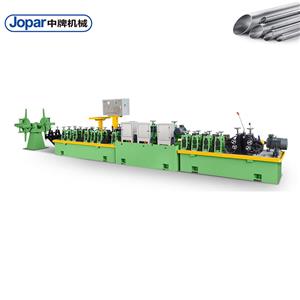
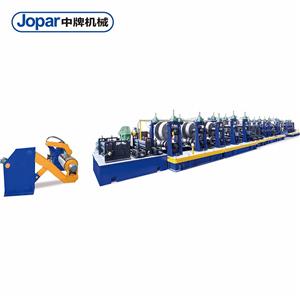
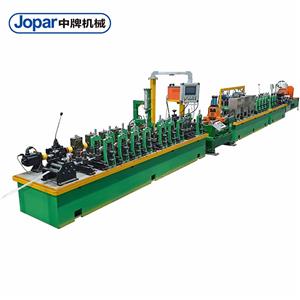
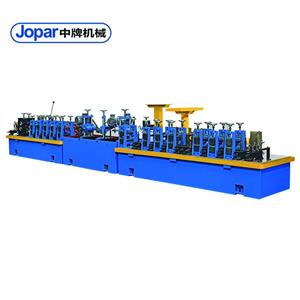
Foshan Jopar Machinery Co., Ltd. addresses these issues head-on with its advanced pipe welding machines. For quality inconsistency, our machines feature closed-loop control systems that monitor arc voltage, wire feed speed, and travel speed in real time. This ensures each weld meets the specified parameters, reducing defect rates to below 1%. For speed, our orbital welding heads can achieve travel speeds up to 24 inches per minute for thin-wall pipes, and our multi-torch setups can weld multiple joints simultaneously. In the German contractor case, switching to Jopar machines boosted their output to 950 joints per week—a 58% improvement. And for rework, our intelligent seam tracking and adaptive welding algorithms compensate for fit-up gaps and thermal distortion, cutting scrap rates by 90%.
Customer Success Stories
1. USA – Houston, Texas
Company: Gulf Coast Fabricators
Challenge: High rejection rate (18%) on 24-inch carbon steel pipes for offshore platforms.
Solution: Jopar PWR-800 orbital welding system with real-time monitoring.
Result: Rejection rate dropped to 2%, production increased by 40%. “Jopar’s machine paid for itself in three months,” said plant manager Mike Donovan.
2. Germany – Duisburg
Company: Rhein-Ruhr Pipeline GmbH
Challenge: Needed to weld 800 joints per week for a natural gas pipeline but only managed 600.
Solution: Jopar dual-torch welding system with automated root pass.
Result: Output hit 950 joints per week, saving $50,000 per month in overtime. “The reliability is unmatched,” commented lead engineer Klaus Schmidt.
3. UAE – Abu Dhabi
Company: Arabian Piping Solutions
Challenge: 12% scrap rate on stainless steel pipes for a power plant.
Solution: Jopar PWR-600 with adaptive welding.
Result: Scrap rate reduced to 1.2%, rework costs slashed by $180,000. “This machine is a game-changer for our quality control,” said operations director Ahmed Al-Rashid.
4. Canada – Edmonton, Alberta
Company: Northern Steel Fabricators
Challenge: Inconsistent root pass penetration on 8-inch schedule 80 pipes.
Solution: Jopar PWR-400 with pulse welding.
Result: First-pass yield improved from 85% to 99%, saving $30,000 annually in rework. Foreman Tom Wilson noted, “Our welders love the ease of use.”
5. Australia – Perth
Company: Outback Pipe Services
Challenge: Needed to weld 3,000 joints for a mining slurry pipeline in remote area.
Solution: Jopar portable orbital welding machine.
Result: Completed project two weeks ahead of schedule, with 100% X-ray pass rate. “The portability and reliability were critical,” said project manager Sarah Chen.
Applications and Partnerships
Jopar pipe welding machines are used in oil & gas (onshore and offshore), chemical processing, power generation, shipbuilding, and water treatment. We have strategic partnerships with global procurement companies like Bechtel, Fluor, and Technip, who specify our equipment for their projects. For example, a recent collaboration with a major Chinese EPC contractor for a refinery in Nigeria used 20 Jopar units, achieving a 99.5% weld acceptance rate.
FAQ
Q1: What welding standards do your machines comply with?
A: Our machines are designed to meet ASME Section IX, AWS D1.1, and ISO 15614. We can also customize parameters for client-specific WPS.
Q2: How do you handle different pipe materials like duplex stainless steel or Inconel?
A: Our machines support a wide range of materials through programmable welding parameters. For nickel alloys, we offer preheat control and slow cooling cycles to prevent cracking.
Q3: Can your system integrate with existing factory automation?
A: Yes, we provide Modbus, Profibus, and OPC UA interfaces for seamless integration with SCADA and MES systems.
Q4: What is the typical ROI period for your machines?
A: Based on our clients’ data, ROI is typically 6-12 months, depending on production volume and labor savings.
Q5: Do you offer remote troubleshooting and software updates?
A: Absolutely. Our machines come with IoT connectivity for remote diagnostics, and we provide firmware updates via secure cloud.
Conclusion
Outdated pipe welding machines are costing you time, money, and quality. With Jopar’s advanced technology, you can achieve consistent welds, higher speeds, and near-zero defects. Don’t let your equipment hold you back. Contact our sales engineers for a free consultation and request our technical white paper on optimizing pipe welding processes. Visit www.joparmachinery.com or email info@joparmachinery.com today.