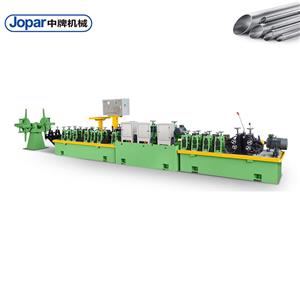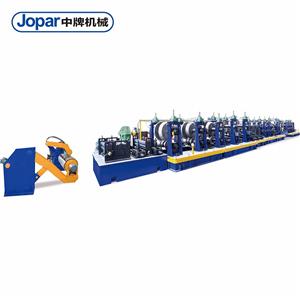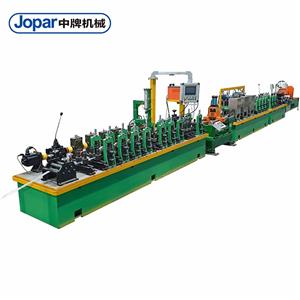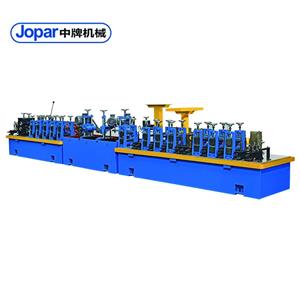
Is Your Automatic Tube Mill Really Efficient?
You’ve just finished a production run on your automatic tube mill. The tubes look perfect—straight, shiny, and uniform. But when you check the quality report, you see a 3% scrap rate due to weld defects. That’s 3% of your raw material, energy, and labor wasted. If you’re running 24/7, that’s not just a minor inefficiency—it’s a significant hit to your bottom line. So, is your automatic tube mill really as efficient as you think? The answer, for many manufacturers, is a resounding no. But it doesn’t have to be that way. In this blog, we’ll dive deep into the common pitfalls that plague even the most modern tube mills and how you can transform your operation from merely running to truly thriving. We’ll explore specific pain points, proven solutions, and real-world examples from companies that have turned their tube mills into models of efficiency, often with the help of experts like Foshan Jopar Machinery Co., Ltd.
Pain Point 1: Inconsistent Weld Quality Leading to Scrap
Let’s face it: weld quality is the heart of tube production. If your weld isn’t consistent, you’re bleeding money. Imagine this: you’re producing 50 tubes per minute, but every 100th tube has a pinhole or a weak weld that fails in the field. The immediate cost is the scrap value of the tube—say $10 per tube. That’s $500 per hour in lost material alone. But the real cost is far greater: customer complaints, potential recalls, and damage to your reputation. Many mills struggle with weld consistency due to fluctuating line speed, variations in strip material, or inadequate weld control systems. The result? A scrap rate that hovers around 2-5%, which for a mid-sized producer can mean hundreds of thousands of dollars annually.
Solution: Advanced Weld Control Systems
The solution lies in integrating intelligent weld control systems that monitor and adjust parameters in real-time. For instance, high-frequency welding with adaptive feedback loops can detect changes in strip thickness or speed and automatically adjust welding power and frequency. This ensures a consistent weld nugget without the need for constant operator intervention. Additionally, non-destructive testing (NDT) systems like eddy current or ultrasonic testing can be integrated inline to catch defects immediately, allowing for instant correction. By implementing these technologies, manufacturers have reported scrap rate reductions from 3% to under 0.5%, saving significant material and energy costs.
Pain Point 2: High Energy Consumption and Operational Costs
Energy is one of the largest operational expenses in tube production. An average automatic tube mill might consume 200-300 kW per hour. If you’re running two shifts a day, that’s over 3,000 kWh daily. At $0.10 per kWh, you’re looking at $300 per day, or nearly $100,000 per year—just for electricity. But many mills are inefficient due to outdated drive systems, poor motor efficiency, or lack of process optimization. For example, oversized motors running at partial load waste energy, and inefficient induction welding systems can consume up to 30% more power than necessary. These hidden costs eat into your margins and make it harder to compete with low-cost producers.
Solution: Energy-Efficient Drive and Control Technologies
Upgrading to energy-efficient components can yield substantial savings. Variable frequency drives (VFDs) on main motors can reduce energy consumption by up to 20% by matching motor speed to actual load. High-efficiency induction welding power supplies with power factor correction can cut welding energy by 15%. Additionally, regenerative braking systems can recover energy during deceleration. But it’s not just about hardware; smart control systems that optimize the entire line—from uncoiler to cut-off—can reduce idle running and minimize peak demand. By conducting an energy audit and implementing these solutions, many mills have achieved 25% reductions in energy costs, translating to tens of thousands of dollars saved annually.
Pain Point 3: Frequent Downtime and Maintenance Issues
Downtime is the silent killer of productivity. A single hour of unscheduled downtime can cost a tube mill $5,000-$10,000 in lost production. Common culprits include tool wear, bearing failures, and hydraulic leaks. These issues are often exacerbated by harsh operating conditions—high temperatures, dust, and continuous operation. Moreover, many mills lack predictive maintenance capabilities, relying on reactive repairs or fixed schedules that either replace parts too early (wasting money) or too late (causing breakdowns). The result is a maintenance cost that spirals out of control and a production schedule that’s constantly disrupted.
Solution: Predictive Maintenance and Robust Design
Implementing predictive maintenance using IoT sensors and analytics can predict failures before they happen. For example, vibration sensors on critical bearings can detect misalignment or wear, triggering alerts for timely replacement. Similarly, thermal imaging can identify overheating in electrical components. But prevention starts with design: choosing components from reputable suppliers, using robust hydraulic systems with leak detection, and ensuring proper lubrication. Additionally, modular designs allow for quick swap-out of worn parts, reducing mean time to repair (MTTR). Companies that have adopted these strategies have seen downtime reduced by up to 40%, and maintenance costs cut by 25%.
Customer Success Stories: Real-World Improvements
Let’s look at how these solutions have transformed operations for some of our clients.
Case 1: Precision Tubes Inc., Houston, USA - This manufacturer of precision tubes for the automotive industry was struggling with a 4% scrap rate due to weld defects. After integrating an advanced weld control system from Foshan Jopar Machinery, they reduced scrap to 0.8% within three months. “The consistency we’ve achieved is remarkable,” says John Miller, Production Manager. “We’re saving over $200,000 annually in material costs alone.”
Case 2: EuroTube GmbH, Stuttgart, Germany - Facing high energy costs, EuroTube upgraded their mill’s drive system with VFDs and high-efficiency welding power supplies. Their energy consumption dropped by 22%, saving €150,000 per year. “The ROI was less than 18 months,” comments Klaus Weber, Operations Director. “We’re now more competitive in the European market.”
Case 3: Southern Steel Works, Melbourne, Australia - Plagued by frequent downtime, Southern Steel implemented a predictive maintenance program with IoT sensors. Downtime decreased by 35%, and maintenance costs fell by 20%. “We’re now running at 95% overall equipment effectiveness, up from 78%,” says Sarah Thompson, Maintenance Manager. “The team is more proactive, and production is smoother.”
Case 4: AsiaTube Manufacturing, Singapore - This high-volume producer of structural tubes was experiencing frequent weld failures due to strip variations. With Foshan Jopar Machinery’s adaptive welding system, they achieved a 0.5% scrap rate and increased line speed by 10%. “The system automatically compensates for material changes, so we don’t have to slow down,” notes Lee Chong, Plant Manager. “It’s been a game-changer.”
Case 5: Nordic Tube AB, Sweden - Focused on sustainability, Nordic Tube sought to reduce energy consumption. By upgrading to energy-efficient motors and controls, they cut electricity use by 28%. “We’re not only saving money but also reducing our carbon footprint,” says Erik Johansson, CEO. “It aligns with our green initiative.”
Applications and Partnerships
Automatic tube mills are the backbone of many industries, from automotive and construction to HVAC and furniture. Our solutions are particularly beneficial for:
- Automotive: Precision tubes for exhaust systems, chassis components, and fluid lines require high weld integrity and dimensional accuracy.
- Construction: Structural tubes and scaffolding demand high strength and consistency, often produced at high speeds.
- HVAC: Copper and aluminum tubes for heat exchangers need clean welds and efficient production.
- Furniture: Decorative tubes require excellent surface finish and straightness.
We’re proud to partner with leading manufacturers and suppliers globally. For instance, we supply tube mills to major steel distributors like MetalCorp in the UK and have a strategic alliance with InduTech in India for local service support. These partnerships ensure that our clients receive not only top-tier equipment but also ongoing technical support and spare parts availability.
FAQ: Technical Questions from Engineers and Procurement Managers
Q1: What are the key factors affecting weld quality in high-frequency tube mills?
The main factors include strip edge condition, welding frequency and power, impeder efficiency, and line speed. Consistent strip quality and precise control of welding parameters are crucial. Our systems use closed-loop feedback to maintain optimal conditions.
Q2: How can we reduce energy consumption without compromising production speed?
Use high-efficiency motors and VFDs, optimize welding parameters, and implement energy recovery systems. Also, ensure proper maintenance of drives and avoid idle running. Our energy audit service can identify specific savings opportunities.
Q3: What is the typical ROI for upgrading to a predictive maintenance system?
Most clients see ROI within 12-18 months through reduced downtime and maintenance costs. The exact figure depends on current downtime rates and maintenance practices.
Q4: Can your weld control system handle different materials like stainless steel and aluminum?
Yes, our systems are programmable for various materials and thicknesses. We provide material-specific parameter sets and can customize for unique alloys.
Q5: How do you ensure spare parts availability and technical support globally?
We have regional service centers and partner with local distributors to ensure quick response. Critical spares are stocked locally, and our engineers are available for on-site support.
Conclusion: Transform Your Tube Mill Today
Your automatic tube mill doesn’t have to be a source of constant frustration. By addressing weld quality, energy consumption, and downtime with proven solutions, you can achieve significant improvements in efficiency and profitability. The success stories we’ve shared are just a glimpse of what’s possible. Are you ready to unlock the full potential of your tube mill? Contact our sales engineers at Foshan Jopar Machinery Co., Ltd for a personalized consultation, or download our technical white paper on “Optimizing Automatic Tube Mill Performance” to learn more. Don’t let inefficiencies hold you back—take the first step towards a more efficient, profitable operation today.