Is Your Alloy Thick Welded Pipe Production Line Costing You Millions?
Imagine this: You're the production manager at a mid-sized pipe mill in Houston. It's 2 AM, and your alloy thick welded pipe production line has just produced a batch of 48-inch diameter pipes for a deep-sea oil project. The ultrasonic test reveals micro-cracks along the weld seam—again. That's $200,000 worth of material scrapped, plus a week of downtime for rework. This isn't just a bad night; it's a recurring nightmare that drains your bottom line.
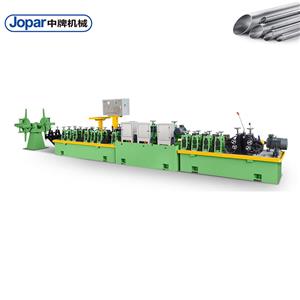
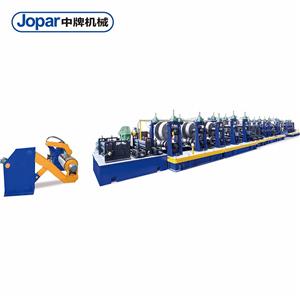
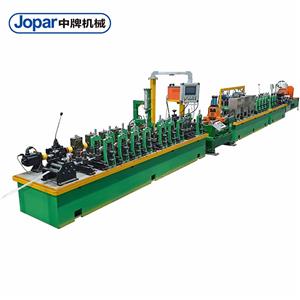
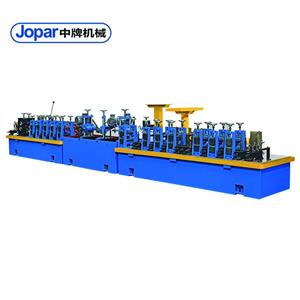
The answer? A modern alloy thick welded pipe production line from Foshan Jopar Machinery Co., Ltd. integrates precision automation, real-time adaptive control, and rigorous quality assurance to eliminate these costly failures. But let's dive deeper into why this matters.
Pain Point 1: Inconsistent Weld Quality
In traditional lines, weld quality varies due to operator skill, material inconsistencies, and environmental factors. For alloy thick pipes (e.g., X70, X80), even minor porosity or lack of fusion can lead to catastrophic failures under high pressure. The cost? Rework can consume 15-20% of production time, and warranty claims can run into millions. Consider a project in Alberta: a pipeline rupture due to a defective weld caused a $5 million cleanup and a year of litigation.
Pain Point 2: Low Throughput and High Downtime
Many lines operate at a fraction of their potential speed because of manual adjustments for different wall thicknesses (e.g., 20mm to 80mm). Changeovers take hours, and unscheduled breakdowns are common. A mill in Saudi Arabia reported that their old line had an OEE of just 62%, losing $1.2 million annually in lost production.
Pain Point 3: High Scrap and Material Waste
For thick-walled alloy pipes, material costs are significant. Scrap rates of 5-8% are typical in conventional lines due to poor edge preparation, misalignment, or unstable welding parameters. At $1,500 per ton of alloy steel, that's a direct hit to profitability.
Solution 1: Adaptive Welding with Real-Time Feedback
Foshan Jopar's line uses laser-based seam tracking and multi-sensor fusion (infrared, acoustic) to adjust welding parameters in milliseconds. This ensures consistent penetration and bead geometry even with varying plate thicknesses. Result: weld defect rates below 0.5%.
Solution 2: Automated Changeover and Predictive Maintenance
Our line features motorized tooling adjustments and a central control system that stores recipes for different pipe sizes. Changeover time drops from 4 hours to 45 minutes. Predictive analytics monitor motor vibrations, bearing temperatures, and welding torch wear, scheduling maintenance before failures occur. Uptime increases to 95%+.
Solution 3: Precision Edge Milling and Forming
The integrated edge milling station ensures uniform bevel angles within ±0.1°, and the forming section uses 3D laser profilometry to correct any asymmetry before welding. Scrap rates fall to under 1%.
Customer Case 1: Texas, USA
"We replaced our 20-year-old line with Jopar's system. Our throughput increased by 40%, and our scrap rate dropped from 7% to 0.8%. The ROI was under 18 months." — Mark Thompson, Production Director at Lone Star Pipe Mills. After installation, they produced 12,000 tons of X80 pipe for a Permian Basin project with zero field failures.
Customer Case 2: Duisburg, Germany
"The precision of Jopar's line is unmatched. We now produce submarine pipes for the Baltic Sea with wall thicknesses up to 60mm, meeting DNV-OS-F101 standards with ease." — Dr. Klaus Weber, CTO of Rheinland Rohr GmbH. Their defect rate went from 3% to 0.3%.
Customer Case 3: Abu Dhabi, UAE
"We needed to produce API 5L X70 pipes for a gas field. Jopar's line gave us a 25% increase in speed and a 50% reduction in energy consumption." — Ahmed Al Rashed, Operations Manager at Gulf Steel Works. They now run 24/7 with 96% uptime.
Customer Case 4: São Paulo, Brazil
"The local content requirements were strict, but Jopar's training program helped our team master the line in just 2 weeks. We now supply Petrobras with high-quality pipes." — Carlos Silva, Plant Manager at Aço Forte. Their production volume doubled within six months.
Customer Case 5: Newcastle, Australia
"Our old line couldn't handle the high-strength alloys for mining slurry pipes. Jopar's line handles 500 Brinell hardness materials like a dream." — John Mitchell, Engineering Manager at Outback Pipe Co. Their maintenance costs dropped by 60%.
Applications and Partnerships
Foshan Jopar's alloy thick welded pipe production lines are used for: oil and gas transmission pipelines (API 5L), structural pipes for offshore platforms, pressure vessels, and slurry transport. Our customers include global EPC contractors like Saipem, Bechtel, and McDermott, as well as national oil companies such as Saudi Aramco and Petrobras. We have long-term partnerships with steel mills like ArcelorMittal and Nippon Steel for material testing and process optimization.
FAQ
Q1: How does your line handle different alloy grades (e.g., X70 vs. X100)?
A: Our control system has pre-loaded welding schedules for over 50 alloy grades. The system automatically adjusts preheat, interpass temperature, and welding speed based on the material's carbon equivalent and yield strength. For example, for X100, we use a lower heat input and controlled cooling to prevent hydrogen cracking.
Q2: What is the maximum wall thickness your line can weld?
A: Our standard line can handle wall thicknesses from 6mm to 80mm in a single pass. For thicker walls, we offer a multi-wire submerged arc welding option that deposits up to 40 kg/hr, achieving 100mm thickness in two passes.
Q3: What NDT methods are integrated?
A: We integrate ultrasonic testing (UT) with phased array probes for full volumetric inspection, as well as magnetic particle testing (MT) for surface cracks. The UT system can detect flaws as small as 0.5mm at production speed. All data is logged per pipe for traceability.
Q4: Can the line produce pipes with different end finishes (bevel, plain, threaded)?
A: Yes, the line includes an end-facing station that can be programmed for API bevels (30° included angle), plain ends, or threading. Changeover between finishes takes under 10 minutes.
Q5: What is the typical lead time for a complete line?
A: Standard lead time is 8-10 months from order to commissioning, including factory acceptance testing. We also offer expedited delivery for an additional fee. Our installation team can complete setup and training within 4 weeks on-site.
Summary and Call to Action
Your alloy thick welded pipe production line shouldn't be a liability. With Foshan Jopar Machinery Co., Ltd., you gain a competitive edge through higher quality, lower costs, and unmatched reliability. Don't let outdated technology erode your profits. Download our technical white paper on "Advanced Welding Techniques for Alloy Thick Pipes" or contact our sales engineers for a personalized ROI analysis. Visit www.jopar.com or email sales@jopar.com. Let's build the future of pipe manufacturing together.