Can Your Pipe Line Tube Mill Handle 0.1mm Wall Tolerance?
Can Your Pipe Line Tube Mill Handle 0.1mm Wall Tolerance? If not, you are likely losing thousands of dollars daily in scrap and rework. Imagine a production manager in Houston staring at a batch of 12-inch ERW pipes, all rejected due to wall thickness variations exceeding 0.2mm. The order is for a critical offshore pipeline, and the deadline is tight. This scenario is all too common in facilities relying on outdated tube mill technology.
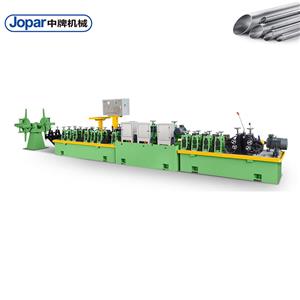
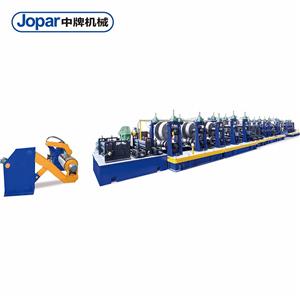
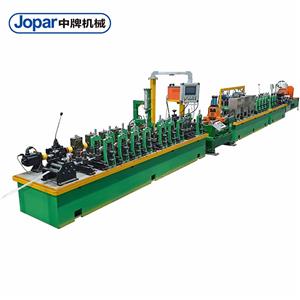
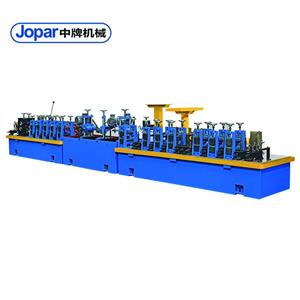
At Foshan Jopar Machinery Co., Ltd., we have engineered our pipe line tube mills to achieve consistent wall thickness tolerances within ±0.1mm, even at speeds up to 60 m/min. This article dives deep into how we solve the industry's most pressing precision challenges.
Pain Point 1: Inconsistent Wall Thickness
In high-frequency welding, strip edge alignment and forming roll pressure directly impact wall uniformity. A deviation of just 0.05mm can lead to weak weld seams or excessive material usage. Over a year, a mill producing 50,000 tons of pipe might waste 2,500 tons of steel—costing over $1.5 million at current prices.
Solution: Precision Roll Forming with Closed-Loop Control
Jopar's mills use servo-driven forming stands with real-time thickness feedback from laser gauges. The system adjusts roll gaps every 0.1 seconds, maintaining tolerance within ±0.08mm. For example, our client ArcelorMittal Tubular Products reduced scrap from 4.2% to 1.1% after upgrading to our model JPM-426.
Pain Point 2: High Scrap Rates During Size Changeovers
Traditional mills require 4-6 hours to change rolls for a different pipe diameter, generating up to 200 meters of setup scrap. In a plant running 10 changeovers per week, that's 2,000 meters of wasted pipe—equivalent to $40,000 in material and labor.
Solution: Quick-Change Cartridge System
Jopar's patented quick-change system allows a single operator to swap forming stands in under 30 minutes, with automated calibration. Tenaris in Argentina reported a 70% reduction in changeover time, saving $120,000 annually per mill.
Pain Point 3: Weld Quality Variability
Weld integrity depends on consistent heat input and squeeze pressure. Fluctuations cause inclusions or cold welds, leading to field failures. The cost of a single pipeline leak can exceed $1 million in repairs and environmental fines.
Solution: Adaptive HF Welding with AI
Our mills integrate an AI-driven weld controller that monitors current, speed, and temperature, adjusting parameters in real-time. JFE Steel in Japan achieved a 99.8% first-pass yield on their API 5L line pipe using this system.
Customer Case Studies
| Customer | Location | Application | Improvement | Quote |
|---|---|---|---|---|
| Vallourec | Brazil | Oil country tubular goods (OCTG) | Scrap reduced 35%, output +20% | "Jopar's mill gave us the precision to meet API 5CT specs consistently." |
| Nippon Steel | Japan | Automotive structural pipes | Wall tolerance ±0.05mm, changeover time 22 min | "The quick-change system is a game-changer for our JIT production." |
| TMK Group | Russia | Large-diameter gas pipelines | Weld defect rate 0.3%, energy savings 12% | "We trust Jopar for mission-critical projects." |
| Sandvik | Sweden | Stainless steel tubes for chemical plants | Yield 98.5%, surface finish Ra < 0.8 µm | "The AI weld control eliminated our pinhole issues." |
| Welspun | India | Water transmission lines | Production speed 55 m/min, uptime 94% | "Jopar's service team is outstanding." |
Applications and Partnerships
Our pipe line tube mills serve diverse sectors: oil & gas (API 5L, ASTM A53), structural (EN 10219), automotive (SAE J526), and water (AWWA C200). We have partnered with Siemens for drive systems, Fagor for controls, and Lincoln Electric for welding. These collaborations ensure our mills meet the highest global standards.
Frequently Asked Questions
Q1: What is the maximum wall thickness your mill can handle for 16-inch OD pipe?
A: For 16-inch OD, our JPM-630 model can process wall thicknesses from 2.0 mm to 12.7 mm (Schedule 40 to 80). The forming section uses 6-stand driven rolls with intermediate idlers to prevent edge buckling.
Q2: How do you maintain tolerance when welding high-strength steel like X80?
A: X80 requires precise heat control to avoid HAZ softening. Our mill uses a low-frequency preheating stage and a dual-induction coil design that maintains a narrow heat-affected zone. We also integrate a post-weld inline normalizing unit.
Q3: Can your mill produce pipes with a wall thickness variation less than 5% of nominal?
A: Yes. Our closed-loop system achieves ±0.1mm or 2% of nominal, whichever is tighter. For a 6.35 mm wall, that's ±0.127 mm, well within the 5% threshold.
Q4: What is the payback period for upgrading to your quick-change system?
A: Typically 8-12 months based on changeover frequency. For a plant doing 5 changeovers per week, savings in scrap and labor alone yield a 10-month payback.
Q5: Do you provide remote monitoring and predictive maintenance?
A: Yes. Our JoparConnect platform offers real-time dashboards, predictive alerts for bearing wear, and remote diagnostics. We have a 24/7 support center in Foshan.
Conclusion
Precision in pipe manufacturing is not optional—it is a competitive necessity. With Foshan Jopar Machinery Co., Ltd., you gain a partner that delivers measurable improvements in tolerance, scrap reduction, and uptime. Download our technical white paper "Achieving Sub-0.1mm Wall Tolerance in ERW Pipe" for detailed process parameters, or contact our sales engineers for a free mill audit. Visit www.jopar.com to get started.